All Activity
- Today
-
-
Banned for taking 3 months to reply to the last ban.
- Yesterday
-
-
Banned for thinking too little!
- Last week
-
L2.5 Je vous salut Marie, pleine de grace, le Seigneur est avec vous, vous etes benie entres toutes les femmes et Jesus, le fruit de vos entrailles est beni. Sainte Marie, Mere de Dieu, priez pour nous pecheurs, maintenant et a l'heure de notre mort. Amen (pour les ames au purgatoire: y inclus Troy)
-
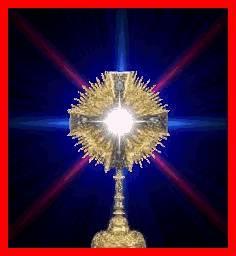
The Holy Eucharist is a meal. On one level, it’s a simple meal of bread and wine. But with prayers and the Holy Spirit, with faith, it is the Sacrament of the Body and Blood of Christ. It can take us back—back perhaps to our very first communion. It can bring back memories of other churches, other altars, other fellow-believers. But it is more than that. This is what makes a Catholic understanding of the Eucharist slightly different from some other perspectives. The Eucharist, this sacred meal of the Body and Blood of Christ by any name—is more than a memorial. The Eucharist takes us back, yes, in history and memory. But the Eucharist also grounds us in the present. And even more amazing, the Eucharist puts us in the future, where we eat and drink with the saints and martyrs, the angels and archangels, the fellow believers of all time and place. In the teaching on the Holy Eucharist, there’s a wonderful part that talks about the benefits of what we do, the benefits of Holy Communion, the Holy Eucharist, the Lord’s Supper. It says simply, “The benefits we receive are the forgiveness of our sins, the strengthening of our union with Christ and one another, and the foretaste of the heavenly banquet which is our nourishment in eternal life.” The “forgiveness of our sins” has to do with the past. I think it’s a complete misunderstanding to think that we have to be completely clean and sinless in order to receive Holy Communion. Pope Francis told us that “the Eucharist is not a prize for the perfect, but medicine and nourishment for the weak!” In saying this he is not suggesting we should go to the Eucharist without thoughtfulness, prayer and presence of mind; but he is also reminding us that all of us, without exception, come to the Eucharist as sinners in need of God’s healing grace and mercy. Pope Francis also provides guidelines for how the Eucharist should make a real difference in our lives and relationships with others. First, he says, we need to relate to people, sharing in their joys, hopes, sorrows and sufferings. Furthermore, this should enable us to reach out to the poor, sick and marginalised people, seeing in them the face of Christ. Second, experiencing God’s forgiveness in the Eucharist should enable us to see ourselves as “forgiven sinners” who are empowered to reach out in forgiveness to others. In this way the Eucharist enables us to overcome pride and division. When we partake of the Body and Blood of Christ, we are forgiven. We are forgiven again. Our sins are washed away at Baptism, but the ongoing accumulation of sin in our life meets its match in Holy Communion. Ignatius of Antioch called it the “medicine of immortality, and the antidote to prevent us from dying, … that we should live for ever in Jesus Christ.” Through the forgiveness of sins the Eucharist recalls the past and wipes the slate clean. The Eucharist is the ultimate palate cleanser. But the second benefit according to the Catechism sets us down squarely in the present. It has to do with strengthening our union with Christ and with one another. In a world that often suggests we live only for ourselves, that we protect at all costs what we think is ours; the unifying work of the Blessed Sacrament is counter-cultural. But it is live-giving. In Communion we are reminded that we need each other. The common cup and common bread underscore that we are not so different from one another, after all. Barriers of race and class and education, differences of national origin are all dissolved in the common chalice. Pope Francis adds Third, the Eucharist should enable us to become active disciples of Jesus Christ. While we Christians do not claim to be better than others, we nonetheless recognise our particular mission is to make Christ known and loved through a spirit of prayer, action and care for all our brothers and sisters, most especially those in need. In the words of Anglo-Catholic poet TS Eliot, Christ is “the still point of the turning world.” It is especially through our celebration of the Eucharist that our distracted, busy, turning worlds are stilled by the overpowering, silent mystery that camouflages the saving, liberating, loving presence of Christ in the broken bread and sweetened wine. For He is indeed truly present among us as the very life of the world. And so, grateful for the redemption of the past, thankful for the mystery of the moment, and glad for the hope that is ours, we celebrate this feast of bread and wine, of Body and of Blood.
-
That's what winning looks like! Cheers!!!
-
L2.4 Je vous salut Marie, pleine de grace, le Seigneur est avec vous, vous etes benie entres toutes les femmes et Jesus, le fruit de vos entrailles est beni. Sainte Marie, Mere de Dieu, priez pour nous pecheurs, maintenant et a l'heure de notre mort. Amen
-
I hope so! We are keeping boy/girl a surprise to everyone including ourselves. Just felt the kicking myself yesterday for the first time.
-
L2.3 Je vous salut Marie, pleine de grace, le Seigneur est avec vous, vous etes benie entres toutes les femmes et Jesus, le fruit de vos entrailles est beni. Sainte Marie, Mere de Dieu, priez pour vous pecheurs, maintenant et a l'heure de notre mort. Amen
-
Indeed - Pride is the first and worst of all deadly sins as no other sin can come about without first pride entering the heart.
- Earlier
-
-
“ pride is one of the seven deadly sins”
-
declining chair
-
Let us pray.
-
-
I think a relative might talk to a priest soon about becoming Catholic.
-

2026 Entrances, Vows, and Ordinations
Gyrovague replied to Luigi's topic in Catholic Vocation Station
The Benedictine community of Mount Saviour Monastery in Pine City, New York also has a non-priest as the head of the community - his title is Prior - Brother John Thompson OSB. It's a small but vibrant community, which raises sheep as a source of income, as well as welcoming many groups throughout the year in its guesthouse, including an annual retreat visit by priests in formation from the Archdiocese of New York. Peace. -
From the archdiocese of Seattle, WA. "Archdiocese of Seattle Sporsondetatc74aa84i1M102m5i00P20M0 uc :u611 7tl4ch5 at05yt0 · On Saturday, June 6, 2026, at 10 a.m. at St. James Cathedral, Deacon Simon Stehr will be ordained a priest for the Archdiocese of Seattle, and Brother Deacon Damien‑Joseph Rappuhn, OSB, will be ordained for the Benedictine community of St. Martin’s Abbey. With gratitude and joy, we join in prayer as these men are configured to Christ the High Priest through the laying on of hands and entrusted with the lifelong ministry of preaching, celebrating the sacraments, and shepherding God’s people. Learn more here: https://ow.ly/WKSO50YYt5i" https://www.facebook.com/photo/?fbid=1311210314460295&set=a.568152028766131 One hidden benefit of reading about ordinations is they almost always mention the name of the local cathedral, and I'm always interested to know the names of the cathedrals around the country. When I travel, I try to attend Mass at the local cathedral and learn the name of it. Until now, I didn't know that Seattle's cathedral is named for Saint James.
-
In the Gospel of John, we hear a clear statement: “ God loved the world so much that he gave his only Son, so that everyone who believes in him may not be lost but may have eternal life.” (John 3:16). That is to say, in the incarnation, life, death, resurrection and ascension of Jesus Christ, God has acted by the power of the Holy Spirit to save the world. This is, in many ways, just rock-solid, basic Christianity. God, in love, has acted, by the power of the Holy Spirit in Jesus Christ, for us and for our salvation. The Trinity is a theological way of making sense of this gospel message in light of the Bible’s unwavering commitment to belief in one God. From beginning to end, in the Old Testament and the New Testament, scripture affirms a faith in the one God, the Holy One of Israel. Jesus himself quotes the ancient Jewish prayer, the Shema, which says, “Hear O Israel: the Lord our God, the Lord is one; you shall love the Lord your God with all your heart, and with all your soul, and with all your mind, and with all your strength.” The early church maintains Israel’s commitment to monotheism, to trust in and loyalty to one God. This is bedrock. How then can we make sense of the salvation that we know in Jesus Christ? One skeptic might ask: Was Jesus really just a very special human being, a teacher or a prophet? The early church said “no.” Jesus was truly human, but not only human, because one human being can’t save other human beings. Only God can save humanity. So, if only God can save human beings, then another skeptic might ask, was Jesus another God? The early church again said “no,” because, as we have seen, they remained committed to belief in one God. This leaves us with the truth that the God we know in the salvation of Jesus Christ is the same God revealed in the Old Testament, the God who acted to redeem the people of Israel. And how do Christians know this? Through the power of the Holy Spirit, the gift of the transforming power of God’s love at work in Christian life and in the wider world. The Trinity is a way of claiming this foundational truth: The God we know in Jesus Christ through the power of the Holy Spirit is one God. Saying “God is Trinity, Father, Son and Holy Spirit,” is a way of naming the God we know in the salvation of Jesus Christ. The action of God in Jesus Christ is the action of the God who is love from beginning to end. The God of love who created us out of and for love. The God of love who took on our humanity, took on the burden of our guilt, and put an end to it on the cross. The God of love who, through the Holy Spirit, now offers us forgiveness, so that we can participate in and share God’s forgiving love with the world. God is love, a Trinity of loving persons, who gives out of love, forgives out of love, and calls us to participate in a community of love through our own acts of giving and forgiving. And so in obedience to Jesus’s command, we go and make disciples, baptizing them in the name of the Father and of the Son and of the Holy Spirit. We baptize them in the name of the God who is love. In baptism, we are buried with Christ in his death, share in his resurrection, and are reborn by the Holy Spirit. We are baptized not only in the name of God, Father, Son, and Holy Spirit, but also into the very life of the God who is love. To be baptized in the name of God, Father, Son and Holy Spirit, is to participate in the love that is God, the love that is known in the life, death and resurrection of Jesus Christ, the love that is poured into every heart. God is love. Those who abide in love abide in God, and God abides in them. Which is to say, God is Trinity. And those of us who are baptized in the name of the Trinity, abide in the love that is Trinity. And the love that is Trinity abides in us. With all of God’s children, we pray on this feast of the Holy Trinity for the “the grace of our Lord Jesus Christ, the love of God, and the fellowship of the Holy Spirit” (2 Corinthians 13:11-13) to inspire us to persist in faith, hope, courage and love.

-
Oh, it's basically like social media meets book tracking. It's mostly for keeping track of the books you've read and want to read, but also has groups, reading challenges, etc. 😊
-
Ive seen it but not sure what it does.
-
Hey! Do any of you all use Goodreads on here? I had an account a few years ago, but deleted it. I was thinking about making a new one.
-
L2.2 Je vous salut Marie, pleine de grace, le Seigneur est avec vous, vous etes benie entres toutes les femmes et Jesus, le fruit de vos entrailles est beni. Sainte Marie, Mere de Dieu, priez pous nous pecheurs, maintenant et a l'heure de notre mort. Amen
-