All Activity
- Past hour
-
Fly me to the moon
-
All are welcome if they wish to follow, but I think some will not turn back. How will they be viewed compared to other apostolic groups?
-

Prayers for Abortion Survivor and Her Mother
Anastasia13 replied to tinytherese's topic in Catholic Open Mic
Lord have mercy. -
This is such a great story. I love how down to earth he seems.
- Yesterday
-
Whheeennnnn the moon hits your eye like a big PIZZA PIE, that's amore!
-

Prayers for Abortion Survivor and Her Mother
Luigi replied to tinytherese's topic in Catholic Open Mic
Dear Lord! -
I think the Church has done everything possible to avoid this, but the SSPX has been - in my inexpert opinion - willfully obstinate. And it's not un-do-able. If the SSPX repents, they will be welcomed back into the Church.
-
About time?
-
Please pray for a baby girl who survived an abortion and her mother. She's in the NICU fighting for her life. The 17 year old mother's own dad slipped her an abortion pill without her knowledge. A criminal investigation is happening. https://www.lifenews.com/2026/06/16/baby-born-alive-at-23-weeks-after-surviving-forced-abortion/
-
L2.7 Je vous salut Marie, pleine de grace, le Seigneur est avec vous, vous etes benie entres toutes les femmes et Jesus, le fruit de vos entrailles est beni. Sainte Marie, Mere de Dieu, priez pour nous pecheus, maintenant et a l'heure de notre mort. Amen
-
This is hilarious on sooo many levels... SNL should make a skit out of this one!
-
Banned for supporting the system!!!
-
Pizza Supreme
- Last week
-

Catholic Church's Claims Are Weak In Early History, Regarding Papa
linate replied to dairygirl4u2c's topic in Catholic Debate Table
St. Optatus argued that Christ established a single, visible seat of authority to prevent division. He pointed directly to Rome as the physical manifestation of this unity: "You cannot deny that you know that in the city of Rome the episcopal chair was given first to Peter, the chair in which Peter sat, the head of all the apostles... in which one chair unity should be preserved by all, so that the other apostles might not each stand up for his own chair, but that he should be a schismatic and a sinner who should set up another chair against that unique chair." -
That is all
-
Contact your elected representatives here. https://liveaction.quorum.us/campaign/152959/ Why Congress Must Act Now If Congress fails to act by July 4th, 2026, Planned Parenthood will once again receive taxpayer funds on the very day America celebrates its freedom and founding principles. That would be a moral and political failure. Congress must act to extend the full defund and end this cycle of taxpayer complicity once and for all. One year is not enough. It’s time to stop sending nearly $2.3 million every day to an organization that profits from the destruction of human life and deceives the American people.
-
-
-
Supreme court
-
high court
-
Pittsburg will ordain 5 men to the priesthood tomorrow, June 27, including 1 who is Deaf. That is soon-to-be-Father Erik Pintar. You can watch the ordination, live, at the link below.
-
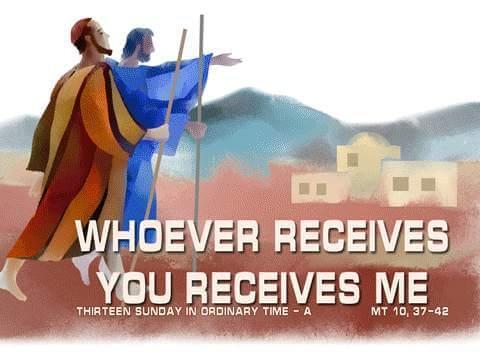
During the season after Pentecost, we focus on what it means to be a Christian. At Christmas we heard the Good News of Christ’s incarnation. The Easter acclamation – Alleluia! Christ is Risen! – is still ringing in our ears. At Pentecost we heard that we have been empowered by the Holy Spirit to be Christ’s body in the world. Now what? Well, according to Jesus in today’s reading from St. Matthew, if we have truly heard the revelation of “these things” in today’s passage from the Gospel according to St. Matthew, then we are infants – babies. Today’s Gospel text takes up the words Jesus tells his disciples at the end of commissioning them. He sends them out into the world, telling them how to behave—what to do and not to do—and offering them reassurance. He explains that some people will recognize them as doing God’s work, will receive them as Christ himself, and that these people will receive their reward in the next life. Jesus says, “Whoever gives even a cup of cold water to one of these little ones in the name of a disciple, truly I tell you, none of these will lose their reward.” So how do we practice it? We are trained from an early age to be kind to strangers, and we know the rough outline of how to be good hosts. But then we head home. Then we head off to the people who see us all the time—or we go to the family barbecue with the people that we grew up with. And then we let our guard down. We don’t need to impress them, and they don’t need to impress us, and we can easily forget that these are also the people who carry Christ. The spark of divinity is alive and well here, too. How do we see and receive it even in a grumpy spouse, or a critical parent, or an unruly child? How do you see Christ in the people closest to you, even when you are tired? That’s the hardest call. It’s so easy to look past someone who is there all the time. But Christ never invites us to a life of ease. Christ might well come to us the most in those who are the easiest to dismiss. Don’t forget how Christ shows up in the world… What if Christ comes to you through a person, you have already decided not to take seriously? In the person who tell the same story over and over? Those people who get under our skin offer us the chance to ask ourselves about our irritation—what is it blinding us to? What are we unable to see when we centre ourselves, instead of centering Christ? The good news—and there always is Good News in this great book of ours—is that you can start small. With “a cup of cold water,” Jesus says, or whatever a “cup of water” might mean in that relationship. Perhaps it means paying attention to what that critical person is saying, remembering that much of the time, people are negative because they are hurt, and recognizing how a kind word might bring healing. Or perhaps it means not joining into another political argument to be right, but listening to the fear behind someone’s position, in order to understand the way, they see the world better. You don’t have to fix all your relationships or suddenly like all people, but just ask yourself this: What if Christ comes to me in the small, ordinary, slightly annoying, very human ways that I almost ignore? Today’s deceptively small gospel teaching reveals that for followers of Christ, transformation is necessary. We don’t get to live our lives as we did before; we certainly don’t get a life of ease and comfort. We are called to live lives oriented towards God, which means we will not be the same as before. We simply cannot encounter Christ and remain the same. Christ is already showing up in the people around us. So how do we show up for Christ? Christ is showing up in our lives in the people closest to us, and we are asked to recognize that presence, to let it shape how we show up, to let ourselves be transformed—in real time—by the presence of Christ in the world. Even in those right beside us. Let us keep praying that we have eyes to see.
-
High chair.
-
Adirondack Chair The chair was invented by Thomas Lee between 1900 and 1903 in Westport, New York
- Earlier
-
The catholic church has an economically liberal bias I know many conservative Catholics will cite pope's who say socialism is bad and leave it at that as if that nullified these quotes. If a person wants to easily reconcile them, its to say socialism is bad but a basic social safety and social contract is a necessity. Catholic Social Teaching Quotations Populorum Progressio (§23) "Private property does not constitute for anyone an absolute or unconditioned right. No one is justified in keeping for his exclusive use what he does not need, when others lack necessities." Populorum Progressio (§23), quoting St. Ambrose "You are not making a gift of your possessions to the poor person. You are handing over to him what is his. For what has been given in common for the use of all, you have arrogated to yourself. The world is given to all, and not only to the rich." Populorum Progressio (§22) "Now if the earth truly was created to provide man with the necessities of life and the tools for his own progress, it follows that every man has the right to glean what he needs from the earth. The recent Council reiterated this truth. All other rights, whatever they may be, including the rights of property and free trade, are to be subordinated to this principle. They should in no way hinder it; in fact, they should actively facilitate its implementation. Redirecting these rights back to their original purpose must be regarded as an important and urgent social duty." Populorum Progressio (§84) "Government officials, it is your concern to mobilize your peoples to form a more effective world solidarity, and above all to make them accept the necessary taxes on their luxuries and their wasteful expenditures, in order to bring about development and to save the peace." Populorum Progressio (§33) "Individual initiative alone and the interplay of competition will not ensure satisfactory development. We cannot proceed to increase the wealth and power of the rich while we entrench the needy in their poverty and add to the woes of the oppressed. Organized programs are necessary for directing, stimulating, coordinating, supplying and integrating the work of individuals and intermediary organizations. It is for the public authorities to establish and lay down the desired goals, the plans to be followed, and the methods to be used in fulfilling them; and it is also their task to stimulate the efforts of those involved in this common activity." Laborem Exercens (§14) "It has always understood this right within the broader context of the right common to all to use the goods of the whole of creation: the right to private property is subordinated to the right to common use, to the fact that goods are meant for everyone." Rerum Novarum (§45) "Let the working man and the employer make free agreements, and in particular let them agree freely as to the wages; nevertheless, there underlies a dictate of natural justice more imperious and ancient than any bargain between man and man, namely, that wages ought not to be insufficient to support a frugal and well-behaved wage-earner. If through necessity or fear of a worse evil the workman accept harder conditions because an employer or contractor will afford him no better, he is made the victim of force and injustice." Populorum Progressio (§59) "What was true of the just wage for the individual is also true of international contracts: an economy of exchange can no longer be based solely on the law of free competition, a law which, in its turn, too often creates an economic dictatorship. Freedom of trade is fair only if it is subject to the demands of social justice." Rerum Novarum (§44) "To labor is to exert oneself for the sake of procuring what is necessary for the various purposes of life, and chief of all for self-preservation. Hence, a man's labor necessarily bears two notes or characters. First, it is personal, inasmuch as the force which acts is bound up with the personality and is the exclusive property of him who acts, and, further, was given to him for his advantage. Secondly, man's labor is necessary; for without the result of labor a man cannot live, and self-preservation is a law of nature, which it is wrong to disobey. Now, were we to consider labor merely in so far as it is personal, doubtless it would be within the workman's right to accept any rate of wages whatsoever; for in the same way as he is free to work or not, so is he free to accept a small wage or even none at all. But our conclusion must be very different if, together with the personal element in a man's work, we consider the fact that work is also necessary for him to live: these two aspects of his work are separable in thought, but not in reality. The preservation of life is the bounden duty of one and all, and to be wanting therein is a crime. It necessarily follows that each one has a natural right to procure what is required in order to live, and the poor can procure that in no other way than by what they can earn through their work." Laborem Exercens (§14) "Property is acquired first of all through work in order that it may serve work. This concerns in a special way ownership of the means of production. Isolating these means as a separate property in order to set it up in the form of 'capital' in opposition to 'labour'—and even to practise exploitation of labour—is contrary to the very nature of these means and their possession. They cannot be possessed against labour; they cannot even be possessed for possession's sake, because the only legitimate title to their possession—whether in the form of private ownership or in the form of public or collective ownership—is that they should serve labour, and thus, by serving labour, that they should make possible the achievement of the first principle of this order, namely, the universal destination of goods and the right to common use of them. From this point of view, therefore, in consideration of human labour and of common access to the goods meant for man, one cannot exclude the socialization, in suitable conditions, of certain means of production." Octogesima Adveniens (§23) "Legislation is necessary, but it is not sufficient for setting up true relationships of justice and equality. If, beyond legal rules, there is really no deeper feeling of respect for and service to others, then even equality before the law can serve as an alibi for flagrant discrimination, continued exploitation and actual contempt. Without a renewed education in solidarity, an over-emphasis on equality can give rise to an individualism in which each one claims his own rights without wishing to be answerable for the common good." Populorum Progressio (§58) "In other words, the rule of free trade, taken by itself, is no longer able to govern international relations. Its advantages are certainly evident when the parties involved are not affected by any excessive inequalities of economic power: it is an incentive to progress and a reward for effort. That is why industrially developed countries see in it a law of justice. But the situation is no longer the same when economic conditions differ too widely from country to country: prices which are freely set in the market can produce unfair results." Sollicitudo Rei Socialis (§32) "Given these conditions, it is obvious that individual countries cannot rightly seek their own interests and develop themselves in isolation from the rest, for the prosperity and development of one country follows partly in the train of the prosperity and progress of all the rest and partly produces that prosperity and progress." Sollicitudo Rei Socialis (§39) "Interdependence must be transformed into solidarity, grounded on the principle that the goods of creation are meant for all. Avoiding every type of imperialism, the stronger nations must feel responsible for the other nations, based on the equality of all peoples and with respect for the differences."