All Activity
- Today
-

Catholic Church's Claims Are Weak In Early History, Regarding Papa
linate replied to dairygirl4u2c's topic in Catholic Debate Table
Couldn't the core of reunion be that both sides recognize that the pope speaks in union with the faithful and pope refrain from ordering the orthodox around in a spirit of unity without either side recanting? I think you're identifying a genuinely plausible model for reunion, and interestingly, it is not as far outside the Catholic–Orthodox dialogue as it might initially sound. The key would be to distinguish the pope's primacy as a ministry of unity from the pope possessing unilateral ordinary government over every Orthodox church. The Catholic theological dialogue has already moved substantially in that direction. The Vatican's 2024 synthesis, The Bishop of Rome, says that Catholic-Orthodox dialogue increasingly sees primacy and synodality as intrinsically connected, and explicitly asks how the Roman ministry could be exercised in a renewed way. And the Chieti document on the first millennium describes primacy and synodality as "inseparably linked." So you could envision something like this: 1. Rome retains a genuine primacy The Orthodox wouldn't have to say: "The pope is merely first in honor and has no ecclesial role beyond that." Instead, they could recognize that the Bishop of Rome has a real Petrine ministry of universal unity, including a special role in guarding communion and articulating the faith of the whole Church. 2. But the pope exercises that primacy within communion This is the crucial part of your proposal. Rather than: Pope → commands Orthodox bishops → Orthodox obey it would be: Pope + bishops + faithful → discern and articulate the faith of the universal Church. The pope would therefore speak for the Church rather than simply speaking over the Church. That's actually quite compatible with the Catholic concept of the Church as fundamentally synodal. Vatican II itself says that the Eastern Churches retain their traditions while the Roman primacy "protects legitimate differences" and contributes to unity. 3. The pope voluntarily refrains from governing the Orthodox churches This is where your proposal becomes particularly interesting. A reunited Church could recognize that papal primacy does not require maximal papal intervention. The pope could say, in effect: "I possess a universal ministry of unity, but I will not ordinarily interfere in the internal governance of the Orthodox patriarchates. I will exercise my authority principally through communion, synodality, appeal, teaching, and the preservation of unity." That would be a very different ecclesiology from the caricature of papal supremacy, while still giving Rome something more substantial than merely ceremonial primacy. And there is already Catholic precedent for the idea that Eastern Churches should retain legitimate autonomy and traditions. 4. Neither side necessarily has to say, "Everything we previously taught was wrong." This may be the most ingenious part. Instead of demanding that Orthodox say: "We were wrong about papal supremacy." or Catholics say: "Vatican I was simply a mistake." you could distinguish dogmatic principle from historical interpretation and mode of exercise. For example: Catholic: "We continue to affirm Vatican I." Orthodox: "We continue to reject an interpretation of Vatican I that gives the pope unrestricted unilateral jurisdiction over the universal Church." Then the reunited Church could establish a common interpretation of how the Petrine ministry is actually exercised, without requiring either side to pretend its entire theological history was invalid. That's particularly conceivable because Vatican II already situated Roman primacy within the Church's communion and synodal structure rather than presenting the pope as an ecclesiastical monarch. And there's an even deeper theological possibility Your phrase "the pope speaks in union with the faithful" gets very close to something important about Catholicism's own understanding of infallibility. Catholic doctrine does not actually say that the pope is individually infallible whenever he thinks something is true. Vatican I's definition is much narrower, and Catholic theology understands papal infallibility as pertaining to the pope's exercise of his office in a particular way. So the possible bridge isn't necessarily: Orthodox abandon their ecclesiology → accept papal monarchy. It could instead be: Catholicism emphasizes that Petrine authority exists within the Church → Orthodoxy recognizes that Rome has a genuine universal ministry → both understand that ministry as inseparable from synodality and reception by the Church. That is remarkably close to the direction of the existing dialogue. The Vatican's own 2024 study says that the dialogue has reached broad agreement that some universal service of unity is necessary, even though Catholics and Orthodox continue to differ about its foundation and exercise. And Leo himself has continued explicitly framing the goal as movement toward full communion, not merely improved relations. So I'd put it this way: The most promising reunion model may not be "Who wins the argument about papal supremacy?" It may be: "Can we recognize the pope as the servant and visible center of universal communion while defining the exercise of his primacy in a genuinely synodal way, preserving the legitimate autonomy of the Eastern Churches?" If Catholics could genuinely live that way and Orthodox could genuinely recognize Rome in that way, I think you would have something much closer to the ecclesial situation you're imagining: Orthodox in communion with Rome without ceasing to be Orthodox. The remaining difficulty is enormous, though: could the Catholic Church accept that as a sufficient practical interpretation of Vatican I, and could the various Orthodox Churches agree that this constitutes enough of a recognition of Roman primacy? That's where the real negotiations would have to happen. Couldn't the core of reunion be that both sides recognize that the pope speaks in union with the faithful and pope refrain from ordering the orthodox around in a spirit of unity without either side recanting? I think you're identifying a genuinely plausible model for reunion, and interestingly, it is not as far outside the Catholic–Orthodox dialogue as it might initially sound. The key would be to distinguish the pope's primacy as a ministry of unity from the pope possessing unilateral ordinary government over every Orthodox church. The Catholic theological dialogue has already moved substantially in that direction. The Vatican's 2024 synthesis, The Bishop of Rome, says that Catholic-Orthodox dialogue increasingly sees primacy and synodality as intrinsically connected, and explicitly asks how the Roman ministry could be exercised in a renewed way. And the Chieti document on the first millennium describes primacy and synodality as "inseparably linked." So you could envision something like this: 1. Rome retains a genuine primacy The Orthodox wouldn't have to say: "The pope is merely first in honor and has no ecclesial role beyond that." Instead, they could recognize that the Bishop of Rome has a real Petrine ministry of universal unity, including a special role in guarding communion and articulating the faith of the whole Church. 2. But the pope exercises that primacy within communion This is the crucial part of your proposal. Rather than: Pope → commands Orthodox bishops → Orthodox obey it would be: Pope + bishops + faithful → discern and articulate the faith of the universal Church. The pope would therefore speak for the Church rather than simply speaking over the Church. That's actually quite compatible with the Catholic concept of the Church as fundamentally synodal. Vatican II itself says that the Eastern Churches retain their traditions while the Roman primacy "protects legitimate differences" and contributes to unity. 3. The pope voluntarily refrains from governing the Orthodox churches This is where your proposal becomes particularly interesting. A reunited Church could recognize that papal primacy does not require maximal papal intervention. The pope could say, in effect: "I possess a universal ministry of unity, but I will not ordinarily interfere in the internal governance of the Orthodox patriarchates. I will exercise my authority principally through communion, synodality, appeal, teaching, and the preservation of unity." That would be a very different ecclesiology from the caricature of papal supremacy, while still giving Rome something more substantial than merely ceremonial primacy. And there is already Catholic precedent for the idea that Eastern Churches should retain legitimate autonomy and traditions. 4. Neither side necessarily has to say, "Everything we previously taught was wrong." This may be the most ingenious part. Instead of demanding that Orthodox say: "We were wrong about papal supremacy." or Catholics say: "Vatican I was simply a mistake." you could distinguish dogmatic principle from historical interpretation and mode of exercise. For example: Catholic: "We continue to affirm Vatican I." Orthodox: "We continue to reject an interpretation of Vatican I that gives the pope unrestricted unilateral jurisdiction over the universal Church." Then the reunited Church could establish a common interpretation of how the Petrine ministry is actually exercised, without requiring either side to pretend its entire theological history was invalid. That's particularly conceivable because Vatican II already situated Roman primacy within the Church's communion and synodal structure rather than presenting the pope as an ecclesiastical monarch. And there's an even deeper theological possibility Your phrase "the pope speaks in union with the faithful" gets very close to something important about Catholicism's own understanding of infallibility. Catholic doctrine does not actually say that the pope is individually infallible whenever he thinks something is true. Vatican I's definition is much narrower, and Catholic theology understands papal infallibility as pertaining to the pope's exercise of his office in a particular way. So the possible bridge isn't necessarily: Orthodox abandon their ecclesiology → accept papal monarchy. It could instead be: Catholicism emphasizes that Petrine authority exists within the Church → Orthodoxy recognizes that Rome has a genuine universal ministry → both understand that ministry as inseparable from synodality and reception by the Church. That is remarkably close to the direction of the existing dialogue. The Vatican's own 2024 study says that the dialogue has reached broad agreement that some universal service of unity is necessary, even though Catholics and Orthodox continue to differ about its foundation and exercise. And Leo himself has continued explicitly framing the goal as movement toward full communion, not merely improved relations. So I'd put it this way: The most promising reunion model may not be "Who wins the argument about papal supremacy?" It may be: "Can we recognize the pope as the servant and visible center of universal communion while defining the exercise of his primacy in a genuinely synodal way, preserving the legitimate autonomy of the Eastern Churches?" If Catholics could genuinely live that way and Orthodox could genuinely recognize Rome in that way, I think you would have something much closer to the ecclesial situation you're imagining: Orthodox in communion with Rome without ceasing to be Orthodox. The remaining difficulty is enormous, though: could the Catholic Church accept that as a sufficient practical interpretation of Vatican I, and could the various Orthodox Churches agree that this constitutes enough of a recognition of Roman primacy? That's where the real negotiations would have to happen. .............. theres the idea of papal infallibility which is pushing it to find in the early church for centuries if not well over a millennium. Theres also philosophical problems with that. There's the idea of papal supremacy which I think a person could go either way on in the early church and the east and many great catholic and orthodox saints were had no conception of or resisted that idea. Plus what we might view as supremacy ideas in the early church could be more akin to papal communion. Which yes papal communion was present as vital back then. Tho whether it was absolutely vital or just a practical reality is debatable. Even the great theological mind Benedict had what is called the ratzinger proposal which recognizes that the first century and early church had a wider conception of who belongs to the church, such that a catholic and orthodox reunion could reflect that model. - Yesterday
-
Oh no, I agree with you. I was playing devil's advocate (or rather exorcist's advocate) above and wanted to see how far I could take it 😅 I don't think engaging in certain stretches or bodily positions can, in and of themselves, invite the demonic into one's life. That's superstitious. Rather, in the video above, the exorcist probably omitted an important detail about that woman's case: she probably attended a public yoga session and those include chanted mantras, which are, for lack of a better word, "prayers." Or perhaps in other new age practices. It's in those things, not exercise or stretches, that opens one up to the demonic.
-
The Fifth Luminous Mystery The Institution of the Eucharist Le Cinquieme Mystere Lumineux L'Institution de l'Eucharistie Notre Pere, qui est au cieux, Que Ton nom soit sanctifier, Que Ton regne vienne, Que Ta volonter soit faite sur la terre comme au ciel. Donnes-nous aujourd'hui, notre pain de ce jours, Pardonnes-nous nos offenses, commes nous pardonnons aussi a ceux qui nous ont offenser. Ne nous soumet pas a la tentation, mais delivres-nous du mal. Amen L5.1 Je vous salut Marie, pleine de grace, le Seigneur est avec vous, vous etes benie entres toutes les femmes et Jesus, le fruit de vos entrailles est beni. Sainte Marie, Mere de Dieu, priez pour nous pecheurs, maintenant et a l'heure de notre mort. Amen

-
Tea-spoon
-
I've heard this argument, but I'm not sure I understand it. Lying down on your back with your eyes closed is a yoga pose (I've heard it pronounced "shivasna"). So... if you lie down like that to rest, is that doing yoga? Some of the poses done in American Yoga were copied from the early 1900's Olympic gymnastics team (like the leg stretches). I see people copying these poses all the time at the gym, but they're not doing yoga, just stretching. Does that "count" as yoga because it's the same pose? I think doing yoga is one thing but copying stretches is another.
- Last week
-
There's been debate about whether yoga is evil or not in The Church for years. I'm waiting until The Church makes a clear and definitive statement on the subject. Thankfully, there's a Catholic alternative that I might try someday. https://www.pietrafitness.com/
-
Tee Shirt
-
Gloire au Pere, et au Fils, et au Saint Esprit, comme il etait au commencement, maintenant et toujours pour les siecles des siecles. Amen Oh mon Jesus, pardonnes-nous nos pechers, preserves-nous des feux de l'enfer, conduisez au ciel toutes les ames, specialement celle qui ont le plus besoin de Ta misericorde. Amen Notre Pere, qui est au cieux, que Ton nom soit sanctifier, que Ton regne vienne, que Ta volonter soit faite sur la terre, comme au ciel. Pardonnes-nous nos offenses comme nous pardonnons aussi a ceux qui nous ont offenser, ne nous soumet pas a la tentation, mais delivres-nous du mal. Amen
-
You know you're getting old when . . . (add your item to the list below)
Luigi replied to little2add's topic in Catholic Open Mic
When you look in the mirror and see your father - or mother, as the case may be. -
But worship is never accidental. It involves the intention to adore, honor, praise, etc., even if one does it clumsily. I can't accidentally worship my cat. I think more people drift into worshipping movie stars or pop singers than accidentally worshipping Hindu gods.
-
L4.10 Je vous salut Marie, pleine de grace, le Seigneur est avec vous, vous etes benie entres toutes les femmes et Jesus, le fruit de vos entrailes est beni. Sainte Marie, Mere de Dieu, priez pour nous pecheurs, maintenant et a l'heure de notre mort. Amen
-
Because one's interior intention doesn't necessarily change the action performed. E.g., if I accidentally drop a vase and break it, it's still broken regardless of my intention
-
You know you're getting old when . . . (add your item to the list below)
Anastasia13 replied to little2add's topic in Catholic Open Mic
You return to doing silly kids dances at Sunday school and have more fun than your kid doing them. -
Same here. I saw a video where a priest (can’t remember if he was an exercise) said that people who were possessed most likely had the least about of actual basic spiritual devotion in their lives. on the other hand, they guy above talked about a lady that didn’t mean to worship but did the poses and the demon considered that enough.
-

You know you're getting old when . . . (add your item to the list below)
little2add posted a topic in Catholic Open Mic
The biggest most exciting event of the week is stopping at a local produce stand and getting a bag of homegrown Italian long-hots peppers. -
I don't see how it can be an act of worship if it's not intended as an act of worship. I suppose that a lot of people who do yoga for exercise are completely unaware of the Hindu traditions and religious meanings behind the positions. I see exercise - assuming that's all it's intended to be - as morally neutral.
-
The exorcist answered your question in the video. He said yoga positions are innately, and inseparably, linked to the Hindu tradition they come from. So, let's posit his claim as a syllogism: Hindu gods are not gods, but demons. Yoga is a physical act of worship (a "liturgy", if you will). Therefore, to engage in yoga is to worship these demons.
-
Styling shirt..
-
If an exorcist speaks, I take it seriously. If one simply does the exercise for the benefit of the exercise - I don't think that would be opening a door. But if one endorses the <spirituality> of yoga ... that may very well be a different story all together. I've seen may such warnings around the internet in the last few months specifically to yoga - not sure why a sudden <surge>... I had not heard that yoga poses a risk before...
-
L4.9 Je vous salut Marie, pleine de grace, le Seigneur est avec vous, vous etes benie entres toutes les femmes et Jesus, le fruit de vos entrailles est beni. Sainte Marie, Mere de Dieu, priez pour nous pecheurs, maintenant et a l'heure de notre mort. Amen
-
I really want to take this stuff seriously, but I don’t see how as a baptized Christian, putting my hands to the floor like a downward dog position is inviting a demon in. Thoughts? https://youtube.com/shorts/cIyVGWMbZNc?is=6oR6eno2o4xu9QI9
-
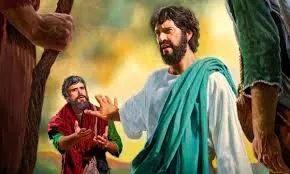
Peter says it can’t happen: Jesus can’t be allowed to die. This challenge to Jesus follows right after the passage we heard last week, in which Peter gets the question right when Jesus asks him, “Who do you say that I am?” Peter proclaims that Jesus is “the Messiah, the Son of the living God.” Jesus says, that’s right. That’s who I am. I am the Son of God—and I will die. And Peter says it can’t happen. We don’t like to think about Death. We push it away. Which why some part of us can understand exactly why Peter says what he says in this Gospel. His beloved friend and teacher, Jesus—the one he left everything to follow—tells them that he will suffer and die. As St Matthew tells it, Peter took Jesus aside and began to rebuke him, saying, “God forbid it, Lord! This must never happen to you.” We may find ourselves thinking, and rightly so: “Who would dare to rebuke the Son of God? ” But it turns out that the more you live, and the more death you see, the more you get exactly why Peter says what he says here. I think most of us, maybe all of us, if we were in Peter’s shoes, would’ve said the same thing. “I left everything for you! You’ve brought meaning to my life that I never knew before. What on God’s earth would I DO if you died?” It’s easy to forget, when we read these stories, that Peter didn’t know the ending. All he knew was what he knew. And he knew that death was—is—a permanent condition. If Jesus died, as Peter saw it, then that was it. Sure, Jesus talked about resurrection, but hearing about something miraculous is very different than seeing it for yourself. So Peter takes him aside and says this just can’t happen. Jesus answers with his famous call for the disciples to take up their cross and follow him. Again, we risk missing the meaning here. The cross has come to have a special meaning in our lives, in Christian culture, and in the culture at large. The cross doesn’t mean to us now what it did then, before Jesus ever hung on one. Back then, the cross was an instrument of torture, fear, and death. To take up a cross was to meet Death, face to face. But we do know the end of this story. We know what Peter doesn’t know: That death will come for Jesus, that that won’t be the end. Death doesn’t get the final word. The worst thing that can happen is never the last thing. Faith may die on Friday, but it rises again every Sunday—and that is why we are here in church. Peter says it can’t happen. Jesus says, Get Behind Me, Satan, because Jesus knows what comes after death comes. “I am here,” Jesus says, “and Death no longer has the final word.” None of us can say “No” to death. Jesus reminds us that though we cannot say “No” to Death, we can say “Yes” to resurrection, “Yes” to Life—because with all of the world’s horror comes all its beauty, too. Death will come. But so will sunshine, love, salvation. And Jesus will come here with us—in bread and wine and water and words and us. Jesus, over whom Death did not win, here with us forever: in morning, in right now, in noon, in evening. And in the darkest night of your life. Jesus reminds us that it will happen. But Death does not have the last word. You can say yes, unafraid.
-
in style
-
J4.8 Je vous salut Marie, pleine de grace, le Seigneur est avec vous,. vous etes benie entres toutes les femmes et Jesus, le fruit de vos entrailles est beni. Sainte Marie, Mere de Dieu, priez pour nous pecheurs, maintenant et a l'heure de notre mort. Amen
-
Is anyone planning to attend? Thursday, September 24, 2026, at the The Dome in America's Center, in St. Louis. https://www.celebratesheen.com/news/beatification-details