All Activity
- Today
-
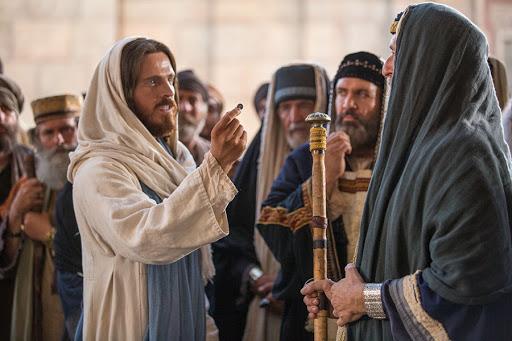
Today, we pick up the narrative of Jesus in Jerusalem and witness his ongoing confrontations with various authorities. This time he is confronted by the Pharisees, concerned with keeping Torah faith despite the ongoing Roman occupation. And there are also gathered some Herodians, those who support the ruling family of Palestine, and therefore are seen by others to collaborate with the Roman Empire. It might seem odd that these two groups would be joining forces, but we know politics and religion often make for strange “bedfellows.” In this case, the Pharisees and Herodians both, for different reasons, have common cause to derail Jesus. Together, they set about to test Jesus in public. They think they have a fool-proof plan to discredit him, bringing forth a question to trap him: about paying the tax to Caesar. If he says Jews ought not pay the tax, some will agree while others will question his sense of what is practical for survival in the Empire. (This was likely the position of the Pharisees.) On the other hand, were he to say “Yes” to paying the tax, such a practical answer will cost him both politically and religiously, possibly to the point of losing the support of his own followers. For in encouraging Jews to pay taxes to the Roman emperor, he would be siding with the descendants of Herod, who, at the beginning of Matthew, slaughtered all of Jesus’s young cousins! It seems a foolproof trap they have laid for him. What could go wrong with their plan? All Jesus says is, ‘Let me see the money you pay the tax with.’ His opponents produce a denarius—which shows an image of the emperor on one side, and an inscription on the reverse: “Tiberius Caesar, august son of Augustus, and High Priest.” This coin, for the Jewish people, is itself a forbidden idol, they were not permitted to be used for offerings at the Temple—thus the reason for the moneychangers in the Temple courtyard. That the Pharisees and Herodians would produce such a coin on the Temple Mount exposes them as hypocrites. Simply by producing the coin, they expose themselves as breaking the rules of the very system they seem to be protecting with their questions! Jesus could stop there, but, after getting them to say whose image appears on the coin, he replies, “Very well, give back to Caesar what belongs to Caesar – and to God what belongs to God.” Jesus turns their question back on them: Knowing what you should know, you decide about the tax. The real question is not about taxes. It’s about who you serve. Jesus is saying in effect, ‘We bear God’s image. We belong to God as surely as your coin belongs to Caesar. Who do you actually serve?’ Remember what Jesus said in the Sermon on the Mount, “You cannot serve both God and wealth!” That is: ‘You cannot serve God and money!’ (Matthew 6:24). Essentially Jesus takes the question posed to him about right practice in tax payment and turns it on its head: ‘Go ahead and toss Caesar a few denarii, but remember that life does not consist in wealth, possessions, and power, but rather in living according to the will of God.’ Jesus, like Paul after him, has one chief concern: Give to God what is God’s. Their teaching echoes down to us with a strong imperative. This is no time for idle chat. No time for idlers. No time for returning to the worship of idols. There’s no time to worry about Caesar. Nor Herod. No time for schemers. It’s time to continue the work of faith, the labour of love, and the steadfastness of hope in our Lord Jesus Christ. Work we must, as if the preservation of the world depends on what we are all doing in this small, otherwise insignificant space we call our life. Because it does matter. The world does depend on what on what we are doing in the small, otherwise insignificant space we call our life. Our life is God’s life. And God’s Life is ours.
-

After 13.5 years of civil marriage, we finally got our marriage convalidated!
veritasluxmea replied to zabbazooey's topic in Catholic Open Mic
congratulations!! You guys look so beautiful, I love the dress and flowers 💛 - Yesterday
-
Guiding Light
- Last week
-
Notre Pere, qui est au cieux, Que Ton nom soit sanctifier, Que Ton regne vienne, Que Ta volonter soit faite sur la terre comme au ciel. Donnes-nous aujourd'hui, notre pain de ce jours, Pardonnes-nous nos offenses, comme nous pardonnons aussi a ceux qui nous ont offenser. Ne nous soumet pas a la tentation, mais delivres-nous du mal. Amen Oh mon Jesus, pardonnes nous nos pechers, preserves nous des feux de l'enfer, conduisez u ciel toutes les ames, specialement celles qui ont le plus besoin de Ta misericorde. Amen
-
G1.10 Je vous salut Marie, pleine de grace, le Seigneur est avec vous, vous etes benie entres toutes les femmes et Jesus, le fruit de vos entrailles est beni. Sainte Marie, Mere de Dieu, priez pour nous pecheurs, maintenant et a l'heure de notre mort. Amen
-

You know you're getting old when . . . (add your item to the list below)
Anastasia13 replied to little2add's topic in Catholic Open Mic
🤣 -
G1.9 Ave Maria, gracia pleina, dominus tecum, benedicta tu in mulieribus et benedicta fructus ventris tui, Iesus. Sancta Maria, Dominus Tecum, ora pro nobis peccatoribus, hunc et in hora mortis nostrae. amen pour Liza et sa famille en ces heures difficiles.
-
G1.8 Je vous salut Marie, pleine de grace, le Seigneur est avec vous, vous etes benie entres toutes les femmes et Jesus, le fruit de vos entrailles est beni. Sainte Marie, Mere de Dieu, priez pour nous pecheurs, maintenant et a l'heure de notre mort. Amen
-
You know you're getting old when . . . (add your item to the list below)
Didacus replied to little2add's topic in Catholic Open Mic
Games you used to play are no longer mere vintage but you actually see them in museums. -
Morning light "It is a poverty to decide that a child must die so that you may live as you wish." Mother Theresa
-

You know you're getting old when . . . (add your item to the list below)
little2add replied to little2add's topic in Catholic Open Mic
You know you are old when you spot that first gray hair...on your kid. -
good morning “Spread love everywhere you go. Let no one ever come to you without leaving happier.” – Mother Teresa
-
G1.7 Je vous salut Marie, pleine de grace, le Seigneur est avec vous, vous etes benie entres toutes les femmes et Jesus, le fruit de vos entrailles est beni. Sainte Marie, Mere de Dieu, priez pour nous pecheurs, maintenant et a l'heure de notre mort. Amen
-
After 13.5 years of civil marriage, we finally got our marriage convalidated!
Didacus replied to zabbazooey's topic in Catholic Open Mic
May Providence forever precede your every steps - congrats! -
Good time...
-
time travel
- Earlier
-

After 13.5 years of civil marriage, we finally got our marriage convalidated!
Luigi replied to zabbazooey's topic in Catholic Open Mic
CONGRATULATIONS! Ad multos annos! -
G1.6 Je vous salut Marie, pleine de grace, le Seigneur est avec vous, vous etes benie entres toutes les femmes et Jesus, le fruit de vos entrailles est beni. Sainte Marie, Mere de Dieu, priez pour nous pecheurs, maintenant et a l'heure de notre mort. Amen
-

After 13.5 years of civil marriage, we finally got our marriage convalidated!
zabbazooey posted a topic in Catholic Open Mic
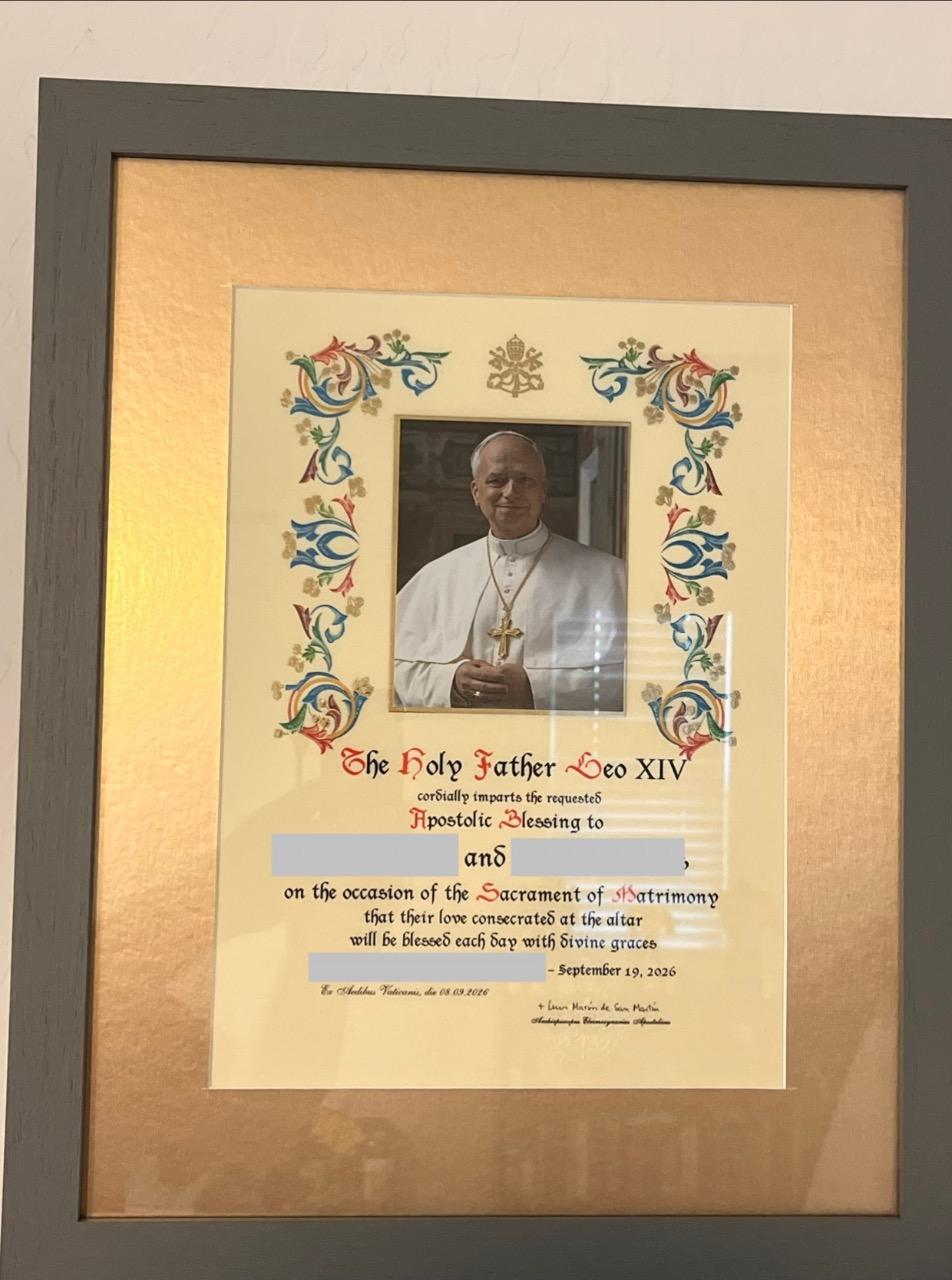
Long time no talk 👋 we had our convalidation recently and it has blessed our lives immensely! Deo gratias! Here’s me and Mr. Zabbazooey ☺️ and my bouquet is made out of legos We also received a blessing from the Pope! It’s hanging in our living room.
-
At the time when St Matthew’s Gospel was being written, there was an cultural and theological argument between two sides of the Jewish community: about whether Jewish Christians or Jewish non-Christians were the ones truly following God. St Matthew is weighing in on the debate. The destroyed city in the parable recalls the Roman decimation of the city of Jerusalem—and the razing of the temple—in 70 AD. The application seems to be that, in the destruction of Jerusalem, God’s judgement has been enacted on the Jewish religious leaders who rejected Jesus. The parable could be Matthew’s way of arguing that Jewish believers in Jesus are the ones truly faithful to God. What if this parable is a mirror held up for us to see our sometimes-distorted notions of God and God’s kingdom—or shall we say God’s “commonwealth”? (Remember: parables invite us to think about God in fresh and vivid terms, asking, “What if…?”) What if God operates outside of our notions of power and control, of scarcity and fear? What if God rejects being depicted as angry or power hungry, rejects being used as an excuse for the crusades or the slave trade or the Doctrine of Discovery? What if Jesus isn’t the bridegroom as depicted in this story—a royal so inconsequential to the lives of his subjects (and to our daily lives now), that he’s ornamental rather than functional? What if Jesus isn’t a prince so negligible that we can offer worship on Sunday and then uphold empire on Monday? If this parable can function as a mirror, the reflections we see in it are not for the purpose of beating up on the church, using shame as a punishment for judgment. What if judgment isn’t exclusively about punishment, but about clear sight and honest repentance, leading to love and liberation? The Rev. Dr. Martin Luther King Jr said it best: “Power without love is reckless and abusive, and love without power is sentimental and anemic. Power at its best is love implementing the demands of justice, and justice at its best is power correcting everything that stands against love.” What if the ridiculous cruelty of this parable is meant to remind us of the simple fact that God is love, and we are beloved? Jesuit priest and author Gregory Boyle addresses this beautifully in his book, Tattoos on the Heart: The Power of Boundless Compassion: God, is more expansive than every image we think rhymes with God … The God, who is greater than God, has only one thing on her mind, and that is to drop, endlessly, rose petals on our heads. Behold, the one who can’t take his eyes off of you. Marinate in the vastness of that. Following love’s logic to its conclusion, let us look again at the parable’s mirror. What if—among the many who are invited—the few chosen are the ones who choose to follow Divine Love incarnate, so that we can all—every human being everywhere—may be called “beloved,” God’s children with whom God is well pleased? What if, because of what was done by Jesus in the outer darkness of Calvary, we really do get to, as Father Boyle says, “marinate in the vastness of a God who can’t take their eyes off of you, and who endlessly drops rose petals on our heads”? What God wants more than anything else is that his children freely choose the life that he has on offer. And so, while we walk on this earth, the invitations are constantly issued to those of us willing to hear. Unlike the man who rejects to wear the wedding garment in this parable, which symbolises living the love and justice that God has created us for, we can respond differently to the king’s gentle question: “’My friend, how is it that you came in here without a wedding garment?’” The gospel reminds us to keep accepting Jesus’ invitations. The eternal life he is calling us to be part of is the one we have been created for.

-
G1.5 Je vous salut Marie, pleine de grace, le Seigneur est avec vous, vous etes benie entres toutes les femmes et Jesus, le fruit de vos entrailles est beni. Sainte Marie, Mere de Dieu, priez pour nous pecheurs, maintenant et a l'heure de notre mort. Amen
-
G1.4 Je vous salut Marie, pleine de grace, le Seigneur est avec vous, vous etes benie entres toutes les femmes et Jesus, le fruit de vos entrailles, est beni. Sainte Marie, Mere de Dieu, priez pour nous pecheurs, maintenant et a l'heure de notre mort. Amen
-
international travel
-
You know you're getting old when . . . (add your item to the list below)
Anastasia13 replied to little2add's topic in Catholic Open Mic
Your dad posts a list of things old people do as he still does all 20, and you’ve done 19 of them. -
"Words from loved ones can stand alone in our memory. Mary’s words invite us to stand still. She invites us to discern God’s will as she did, as Juan Diego did." https://fscc-calledtobe.org/2026/09/30/franciscan-sisters-favorite-our-lady-of-guadalupe-quotes/