All Activity
- Today
-
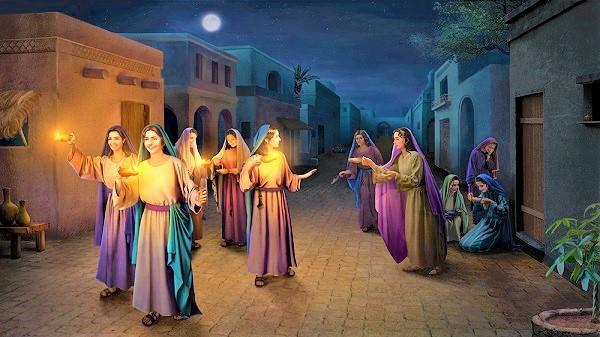
The parable Jesus tells is about a wedding feast and waiting. In Jesus’ day, a wedding ceremony would usually be held in the bride’s family home. The wedding feast afterward would be held in the groom’s family home and would start at night. It lasted about a week, not just one night, so a lot of preparation had to be done. When the feast was set to begin, the groom would come get his bride, and together they would walk to the wedding banquet with the bridesmaids, who had one job: accompany the bride and groom to the banquet, holding lamps to light the way for them to walk to the feast. That’s it. Provide the light. These lamp-bearing bridesmaids aren’t decorative. They have just one job, but it’s important: bring the light. Get the bride and the groom safely through the dark and to the big feast. Except, in the parable, only half of the bridesmaids were prepared to wait for the bridegroom. The other five weren’t. So, when the moment comes, they’re off at the all-night oil store trying to get a refill for their lamps. Eventually, they do, but by the time they arrive, the party has started, the door has been locked, and for those five bridesmaids, it’s a case of too little, too late. In church tradition and biblical language, the bridegroom is a symbol of Christ, and the bridegroom’s arrival, a symbol of the Second Coming of Christ, when he will bring the faithful to the heavenly banquet, a great feast, a party that will last not just a week, but for eternity. We’re still waiting for the arrival of the bridegroom. Whether we’re waiting for the Second Coming of the Lord, waiting to meet our Lord when we die, waiting for the Lord to come to us with the help we need, the answer we’re praying for, the comfort we’re looking for, we are still waiting. How are you at waiting? We don’t like waiting, but God promises us blessings even as we wait. God says in Isaiah 40:31, “Those who wait for the Lord shall renew their strength; they shall mount up with wings like eagles; they shall run and not be weary; they shall walk and not faint.” Waiting is not doing nothing, and having to wait for the Lord doesn’t mean the Lord is doing nothing. We can wait, trusting that God is always doing something. God is not helping another customer while we languish in line. God is at always at work, doing “far more than we can ask or imagine,” according to Ephesians 3:20. We can be ready, like wise bridesmaids with our one job of bringing the light, or we can be fools, untrusting, unaware, unprepared to do our part. Waiting doesn’t mean inactivity. Having oil at the ready, being prepared, comes from doing what we’re told to do, being obedient to God, being formed by God’s power at work in us. So, how do we keep this oil on hand? By some practices and disciplines that are the same for all of us—prayer, reading the Scriptures, worship with others caring for people and the planet. It’s using what God gives us to keep us going, to recharge, to stay connected with God and God’s love. Do you see why the wise bridesmaids can’t just share their oil? Yes, sharing is a Christian virtue, but some things just don’t work that way. Your friend has a marvellous marriage. There’s no way to borrow some of that. Another has a vibrant and sustaining prayer life. Yes, she can pray for you, but she can’t take your place in a friendship with God. You can be influenced or inspired by someone else’s peace of mind and confident trust in the Lord, but they can’t just give you some of theirs. We have to get that oil for ourselves. And yes, as much as we don’t like it, time does run out. You can’t say forever, “Someday I’ll spend time with my children, my spouse.” “Someday I’ll get back to church, back to praying.” “Someday I’ll make that phone call, make that donation.” Or, really, we can say it all we want, but someday, there will be a shout, “Look! Here is the bridegroom! Come out to meet him!” There is such a thing as too little, too late. We don’t like it, but there it is. But here is the good news: we’re still here. We’re still here, hearing this parable. It is not too late. And remember, it’s a party Jesus wants to take us to. He’s preparing a great feast for us.
-
Notre Pere, qui est au cieux, Que Ton nom soit sanctifier, Que Ton regne vienne, Que Ta volonter soit faite sur la terre comme au ciel. Donnes-nous aujourd'hui, notre pain de ce jours, Pardonnes-nous nos offenses, commes nous pardonnons aussi a ceux qui nous ont offenser. Ne nous soumets pas a la tentation, mais delivres-nous du mal. Amen Oh mon Jesus, pardonnes nous nos pechers, preserves nous des feux de l'enfer, conduisez au ciel toutes les ames, pseicalement celles qui ont le plus besoin de Ta misericorde. Amen
-
out doors
-
time out
-
Between my grandmother and four of her daughters, they had 46 children. None of them are in the Church Militant now, but I pray with them daily for Mrs. Chrysostom, a safe delivery, and a healthy baby. And then when I have to go do stuff, I ask them to continue the prayers - after all, what else have they got to do?! So fear not! All of you are in good hands.
-
Do you keep up with him? If you do, tell him to stop by and leave a pithy and apropos remark!
-
He is one of the best of us.
- Yesterday
-

Catholic Church's Claims Are Weak In Early History, Regarding Papa
linate replied to dairygirl4u2c's topic in Catholic Debate Table
St. Optatus of Milevis (fourth century) is one of the important early witnesses to the Roman Church's understanding of the authority of the Chair of Peter. His most famous discussion appears in Against the Donatists (De Schismate Donatistarum), Book II, Chapter 2. It is particularly interesting because Optatus was writing against the Donatist schism, arguing that the unity of the Church could not be separated from communion with the Church of Rome. ### 1\. The famous passage on the Chair of Peter > "You cannot then deny that you do know that upon Peter first in the City of Rome was bestowed the Episcopal Chair, on which sat Peter, the Head of all the Apostles ... that, in this one Chair, unity should be preserved by all, lest the other Apostles might claim—each for himself—separate Chairs, so that he who should set up a second Chair against the unique Chair would already be a schismatic and a sinner." — Against the Donatists, II.2. Tertullian.org +1 This is particularly significant because Optatus explicitly connects Peter, Rome, and the preservation of universal ecclesial unity. ### 2\. The succession of Peter Optatus continues by identifying the succession of bishops occupying Peter's chair: > "Therefore, in the one Chair, which is the first of the endowments, Peter first sat, to whom succeeded Linus; to Linus succeeded Clement..." He then traces the succession down to the Roman bishop of his own time. New Advent +1 ### 3\. Rome and the universal communion of the Church Optatus identifies the contemporary Bishop of Rome as an important point of communion for the worldwide Church: > "...to Damasus succeeded Siricius, who is today our colleague, with whom the whole world agrees with us in the fellowship of one communion." — Against the Donatists, II.3. New Advent +1 This is important because Optatus isn't merely talking about Rome having historical prestige. He is describing communion with Rome as a characteristic of the universal Catholic Church. ### 4\. Peter and the keys of the Kingdom In Book II, Chapter 4, Optatus makes another striking argument: > "Peter received the saving Keys ... Peter, that is to say, the first of our line, to whom it was said by Christ: 'To thee will I give the Keys of the Kingdom of Heaven,' and these keys, 'the gates of Hell shall not overcome.'" He then challenges the Donatists: > "How is it, then, that you strive to usurp for yourselves the Keys of the Kingdom of Heaven, you who, with your arguments, and audacious sacrilege, war against the Chair of Peter?" — Against the Donatists, II.4. Tertullian.org +1 ### 5\. The Chair of Peter as belonging to the Catholic Church Later, Optatus summarizes his argument: > "...through the Chair of Peter which is ours ... the other endowments also belong to us." — Against the Donatists, II.23. Tertullian.org +1 ### What makes Optatus particularly important historically? I think three aspects of his testimony deserve particular attention: 1\. Petrine primacy: He explicitly identifies Peter as the head of the apostles and the first occupant of the episcopal chair at Rome. 2\. Roman ecclesial unity: He considers the Roman chair a unique instrument for preserving unity among Christians throughout the world. 3\. Communion with Rome: He treats communion with the Roman bishop as an important criterion distinguishing the Catholic Church from schismatic communities. There is also an important historical qualification: Optatus was writing against the Donatists, a North African schismatic movement. His immediate argument concerns ecclesial unity, legitimate episcopal succession, and communion with Rome. He does not systematically articulate every aspect of the later Catholic doctrine of papal jurisdiction or infallibility. Nevertheless, his testimony is remarkably explicit for a fourth-century Father. Primary source: [Optatus, Against the Donatists, Book II (complete English translation, 1917)](https://tertullian.org/fathers/optatus_02_book2.htm?utm_source=chatgpt.com). You might find Optatus especially interesting in your exploration of the relationship between early Catholic unity and the later development of papal authority. His writings provide substantial evidence that Rome's special Petrine role was not simply a medieval invention. -
G2.10 Je vous salut Marie, pleine de grace, le Seigneur est avec vous, vous etes benie entres toutes les femmes et Jesus, le fruit de vos entrailles est beni. Sainte Marie, Mere de Dieu, priez pour nous pecheurs, maintenant et a l'heure de notre mort. Amen
-
Will do - give update when you can! God bless.
-
time travel
-
 Credo in Deum changed their profile photo
-
Video Explaining Different Rites of the Church
Credo in Deum replied to tinytherese's topic in Catholic Open Mic
It doesn’t happen. That’s my point. It should happen and for some reason it’s not. Even within the Latin Rite there are NO parishes closing when they could be given to EF apostolates. The irony too is that hierarchy would rather sell churches than allow the same Mass that was celebrated by the original missionaries of said countries and states. The same Mass we’ve been told we should have no problem leaving because the NO is just as valid as the EF and yet despite the EF being the same valid Mass it’s for some reason not good enough to keep around in order to save failing parishes. Weird. - Last week
-
I’ve been binging the George Lopez show, and it’s one of the few sitcoms where they talk about the kids staying virgins instead of couples sleeping together. That’s kind of cool.
-
Who dat?
-
-
Video Explaining Different Rites of the Church
dUSt replied to tinytherese's topic in Catholic Open Mic
Yes, but when does this ever happen? -
dUSt?
-
I would personally add: 1) AnneLine 2) arFink 3) Cartermia
-
FuturePriest would have to change his name to CurrentPriest.
-
Baby is ready to come out, we are just waiting around for labor to kick in. Prayers for a healthy birth, please!
-
memento mortuorum
-

You know you're getting old when . . . (add your item to the list below)
little2add replied to little2add's topic in Catholic Open Mic
been their, done that! -
All Hallows' Eve means "holy evening" and refers to the night of October 31, which serves as the traditional vigil or eve preceding All Saints' Day (All Hallows' Day) on November 1st All Saints' Day November 1st, is a Christian solemnity and festival celebrated to honor all the saints of the church, both known and unknown, who have attained heaven All Souls' Day November 2nd, is a day of prayer and solemn remembrance dedicated to honoring the faithful departed. Observed primarily by the Roman Catholic Church, Sunday, November 1, 2026 – Solemnity of All Saints - is a Catholic Holy Day of Obligation, in the United States: memento mortuorum
-
Happy Halloween 🎃
-
Real.