All Activity
- Past hour
-
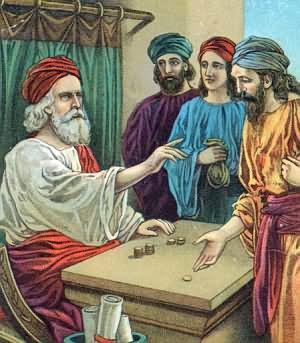
Our gospel reading continues this week with another parable, this time the parable of the talents In the first century, the Greek word talanton (τάλαντον) meant a unit of weight used for precious metals, and therefore a unit for reckoning very large sums of money. It’s not just a coin that could get you a sack of flour. For example, a denarius, which was the Roman silver coin at the time, was a daily wage for a common labourer or soldier. A talent, gold or silver, was about 33 kg. Commonly, a talent was reckoned as about six thousand denarii. That means a talent is the equivalent of six thousand working days, roughly 16 years of labour. We have then these three slaves, who are all entrusted with fortunes of different magnitudes. The one who gets the most doubles it; the one who gets considerably less also doubles it. And they both receive the same praise from the master, both will be entrusted with other things, because they have proved their trustworthiness. The third slave receives this fortune, and, although it is a lot less than the other two, it is still a fortune. And he doesn’t trust himself to do something good with it, so he buries it. Nothing good can come out of it when it is buried into the ground out of fear. When it is time for him to account to his master what he did with the talent, he blames the master for being harsh: But his master replied, ‘You wicked and lazy slave! You knew, did you, that I reap where I did not sow, and gather where I did not scatter? Then you ought to have invested my money with the bankers, and on my return, I would have received what was my own with interest.” The master is saying that even if those things were true about him—and the slave thought him harsh—he could still have done something safe with the talent, something that held practically no risk of loss. But instead, the slave chose to bury it. In his sermon on this text, John Chrysostom says: “For nothing is so pleasing to God, as to live for the common advantage. For this end God gave us speech, and hands, and feet, and strength of body, and mind, and understanding, that we might use all these things, both for our own salvation, and for our neighbours’ advantage.” In other words, the gifts of God are never just about us as individuals. Yes, they are given to us, but they are not given only for us. The talents have to benefit the community. Parables can be read in so many ways, and they always have something to teach us. We can read this parable and hear a message about money, and that message would be true. We can read this parable and hear a message about our talents, our God-given gifts, and that message would be true… Now, what if this enormous fortune that is entrusted to each one of the slaves is love? Let’s see what happens when we read it that way. One slave receives five enormous measures of love and immediately goes out and puts it out there and soon it doubles. The one that receives two measures does the same. They both double what they got. The love of God, shining through them, multiplied the love that exists in the world. And the third one buried it in the ground. Didn’t share it, didn’t even hold on to it, but out of fear buried it into the ground, that it could not even be enjoyed by himself nor by others. Seen in this light, the third slave doesn’t come across as cautious, he comes across as selfish and afraid. He is closed off to the possibility of being in relationship. Instead of investing in community, he refuses to participate. We tend to think that if we give something away, then we have less of it. But love does not work like that. If we love another person well, we have not depleted some finite supply of love that we now need to replenish. And what’s more: there is more love now in the world because that person will pass it along to those with whom they are in relationship. The person who receives that love now has love that they can share with someone else. Maybe they are more patient with their children. Maybe they welcome someone. Maybe they forgive. And suddenly the love that we received from God and given to one person is moving through people we may never even meet. That is a pretty extraordinary “return on an investment.” We will never know what the final number is. We don’t get to track how much good our love produced or how far it travelled. Only God knows that final tally. Our work is to receive what God has given us and put it back into circulation. And in that way, an enormous fortune grows.
- Yesterday
-
Many congratulations to you, Mrs. Chrysostom, and Sonny Boy Chrysostom! Oh blah dee, oh blah dah, life goes on!
-
Thank you ever so kindly. May God reward you! Baby boy Chrysostom is born in as safe, healthy and holy a birth as one could ever hope for.
- Last week
-
From most of the Catholics I am around (i.e. family), they do not practice: You Shall Love Your Neighbor As Yourself. There is really a lack of empathy present.
-
I'm still in shock/denial about all the Catholics who support Trump/ the current Republican Party...
-
I'll be 40 in March. I started here in my teens.
-
J3.5 Je vous salut Marie, pleine de grace, le Seigneur est avec vous, vous etes benie entres toutes les femmes et Jesus, le fruit de vos entrailles est beni. Sainte Marie, Mere de Dieu, priez pour nous pecheurs, maintenant et a l'heure de notre mort. Amen
-
the memes in here are...yikes.
-

The catholic church has an economically liberal bias
rachael replied to linate's topic in Catholic Debate Table
No, it is not. Communism: Philosophy based on the equitable distribution of wealth among a nation’s citizens and common ownership of all property. In particular, it calls for the control of the means of production, such as manufacturing and agriculture, by the working class, or the proletariat. Its ultimate goal is to achieve a classless society. Socialism: Socialism encompasses a broader spectrum of political beliefs but shares communism’s emphasis on an equitable distribution of wealth among citizens, as well as public ownership of the means of production, though not necessarily all of them. Socialist programs and policies can exist alongside capitalism in a society (i.e. libraries, free public education, Medicare for all), which is less likely in a communist system. Socialists may or may not see a communist system as their end goal. Is Communism a Form of Socialism? While related, socialism and communism are different. Socialism, for instance, seeks to bring equality to the means of production to the working class. Communism takes this a step further and revolutionizes both aspects of production and consumption. In that respect, communism can be viewed as a more extreme version of socialism. https://www.investopedia.com/ask/answers/100214/what-difference-between-communism-and-socialism.asp -
I guess we aren't aware of the origins and history of fascism in this thread.
-
card game
-
J3.4 Je vous salut Marie, pleine de grace, le Seigneur est avec vous, vous etes benie entres toutes les femmes et Jesus, le fruit de vos entrailles est beni. Sainte Marie, Mere de Dieu, priez pour nous pecheurs maintenant et a l'heure de notre mort. Amen
-
The rumors of my death are grossly exaggerated. Although just to make you all feel ancient, I turned 30 last month. Am I officially no longer a fetus? I miss Lil Red. And Hassan. He is never to know this, but in my weaker moments I even miss Kujo.
-
Ok.
-
place card
-
J3.3 Je vous salut Marie, pleine de grace, le Seigneur est avec vous, vous etes benie entres toutes les femmes et Jesus, le fruit de vos entrailles est beni. Sainte Marie, Mere de Dieu, priez pour nous pecheurs, maintenant et a l'heure de notre mort. Amen (pour les ames au purgatoire)
-
"By the way...hello from a random European country!" You realize it's random only to us, right? The people who live there don't consider it random, doncha guess? But anyway, enjoy your randomness and yourself!
-
Don't lie. You chat with me every few months on LinkedIn. Also, I am old and trying to get a PhD in a random European country. Well, working towards it. These applications are awful. By the way...hello from a random European country!
-
J3.2 Je vous salut Marie, pleine de grace, le Seigneur est avec vous, vous etes benie entres toutes les femmes et Jesus, le fruit de vos entrailles est beni. Sainte Marie, Mere de Dieu, priez pour nous pecheurs, maintenant et a l'heure de notre mort. Amen
-
LUMINISCENCE: St. Patrick's Cathedral in NYC
Didacus replied to little2add's topic in Catholic Open Mic
***GASP!!!** ***WHOA!*** -
*sigh* - I miss Littleles... and Apathy....
-
Were any of you ever active on Catholic Answers Forum? I used to talk to two people on there that I ended up losing contact with. Their usernames were Starsmurf and Paul Infirdigno. We talked almost every day on CAF. From time to time I still wonder what happened to them and how they're doing and will say a quick prayer for them.
-
We do keep in touch, yes. :)
-
Discover St. Patrick’s Cathedral as you've never seen it before !A live orchestra, choir, and immersive 360° projections reveal St. Patrick’s Cathedral in an engaging new way. Exclusive Christmas shows - November 18, 2026 to January 2, 2027 https://feverup.com/m/533758?thm=5381&cp_landing_source=luminiscence&utm_source=Facebook_Mobile_Reels&utm_medium=ad_cbo&utm_campaign=533758_nyc&ad_id=120254454194250022&utm_content=120254454194250022&utm_term=120254245226080022&fbclid=IwY2xjawVcJ6pleHRuA2FlbQEwAHBkb2YBYWRpZAGrOy_zABJ2c3J0YwZhcHBfaWQQMjIyMDM5MTc4ODIwMDg5MgABH6aV9HsP38AGtLAvt-xPKvy-Y7p0bKJWwF5Lxfyqrhtcdu5f6qXiwzL2ReKH_aem_VyFs4XQbWm0to46CEfRFJw
-

PHILADELPHIA CARMEL: “The Exodus in the 70s”
graciandelamadrededios posted a topic in Catholic Vocation Station
At this time, the “Winds of Change” were blowing harshly upon the Carmelites of Philadelphia. There was a divergence of outlook among the Nuns, and shortly before the Philadelphia Carmel joined the St. Joseph’s Association, there occurred what one of the survivors called “The Exodus in the 70s”: a significant number of the Nuns left the Philadelphia Carmel for other Carmels, and some of them left religious life all together. From then on, the Community struggled to maintain an adequate number of Nuns. Carmelites came from other Carmels, for shorter or longer periods of temporary transfers. Unlike Benedictines, Carmelites do not make a vow of stability which binds them to that community for life. However, on making her solemn profession a Carmelite is incardinated into her Community and it is a very special and unusual circumstance which would make her change to another Carmel. A Sister cannot be transferred without her free consent and that of the Chapters of both communities. This is always challenging. Though Discalced Carmelite communities share the same spirituality, each Carmel lives it in its unique spirit and expression. To transfer from the Community where one was formed to another, is like going from one’s birth family to live with cousins one has seldom met. This can be very bewildering, both spiritually and psychologically, both for the Sister who makes the transfer and for the community who receives her. And the close contact with one another which is the result of our enclosed contemplative life makes the challenge even greater. The Philadelphia Carmel experienced this kaleidoscopic shifting of relationships for over 30 years. The Community never attained a measure of peaceful stability, nor did its number of members increase, in spite of nuns coming from various Carmels to keep the Carmel going. By 2012, there were only 5 Sisters in the community, one of whom was mentally impaired and unable to take part in Chapter decision. by Sr. Gabriella of Flemington Carmel