All Activity
- Today
-

Catholic Church's Claims Are Weak In Early History, Regarding Papa
linate replied to dairygirl4u2c's topic in Catholic Debate Table
you have pinpointed one of the most famous textual ambiguities in all of church history. When [Cyprian of Carthage] (AD 251), his use of the phrase "the Chair of Peter" sparked a massive debate over whether he meant the office of the local Bishop of Rome specifically, or the office of every bishop globally. [1, 2] The text is a primary battlefield for three major reasons: ## 1. The Theological Ambiguity (Rome vs. All Bishops) Protestant and Eastern Orthodox historians emphasize that throughout his writings, Cyprian uses "the Chair of Peter" as a symbol for the entire episcopate. [2, 3] * * The Orthodox/Protestant Argument: In Chapter 4, Cyprian explicitly writes that Christ gave equal power to all the Apostles after His resurrection. In Cyprian's theology, Peter was given the keys first simply to symbolize that the Church must start from a point of unity. Therefore, every valid bishop sits on the "Chair of Peter" in his own diocese. This explains why Cyprian felt perfectly entitled to fiercely resist [Pope Stephen I](https://en.wikipedia.org/wiki/Pope_Leo_I) during their later baptismal controversy—he viewed Stephen as an equal, not a master. [1, 3, 4, 5, 6, 7] * The Catholic Argument: Catholic scholars counter by noting that Cyprian frequently refers to the Church at Rome specifically as "the Chair of Peter" and "the principal church, in which sacerdotal unity has its source" (Epistle 59:14). They argue that even if all bishops share in the episcopal power, Rome remains the physical anchor and permanent geographic center of that Petrine unity. [8, 9, 10] * ## 2. The Textual Mystery (The Two Versions) The ambiguity is deeply complicated by a historical anomaly: there are two different versions of Chapter 4 in the surviving ancient manuscripts. [11, 12] * * The "Primacy Text" (PT): Contains explicitly papal-sounding phrases, such as: "If a man does not hold fast to this unity of Peter, does he imagine that he still holds the faith? If he deserts the Chair of Peter upon whom the Church was built, has he still confidence that he is in the Church?" [13, 14] * The "Received Text" (RT): Lacks these phrases, emphasizing instead that the other Apostles were exactly what Peter was—endowed with an equal share of honor and power. [1, 5, 15, 16] * For centuries, Protestants accused Catholics of forging the "Primacy Text" to invent early evidence for the Papacy. However, modern historical consensus (even among non-Catholic scholars) reveals a more fascinating truth: Cyprian wrote both versions himself. [11, 12, 17, 18, 19] ## 3. Why Cyprian Rewrote His Own Book Historians generally agree that Cyprian edited his own text over time to prevent his words from being weaponized. [11, 12] * * Why he wrote the Primacy Text: He originally wrote it during a schism in Rome where a rebel named Novatian tried to set himself up as a rival bishop against the true Pope, Cornelius. Cyprian wrote the strong "Chair of Peter" language to tell Roman Christians they must stay united to their true, lawful bishop. * Why he changed it to the Received Text: A few years later, a new Pope (Stephen I) began using those exact same lines to claim absolute, unilateral authority over North Africa during a theological dispute. Realizing his pro-unity words were being turned into a tool for Roman dominance, Cyprian revised Chapter 4 to soften the focus on Peter and strongly emphasize the shared equality of all bishops. [1, 3, 5, 7, 11, 12, 20] * Your instinct is historically spot on. The text is inherently ambiguous because Cyprian was trying to balance two competing concepts: the high spiritual respect owed to Rome as the symbol of unity, and the structural equality of all local bishops. [1, 21] I will tailor my next response. Just tell me: * * 📜 The exact text of Epistle 59 where he calls Rome the "principal church" * 💧 How Pope Stephen used this text against Cyprian in the baptism fight * 🔍 Other early examples of manuscript alterations in church history [8] * Just reply with your answer or a new query: [1] [https://www.the-highway.com](https://www.the-highway.com/Matt16.18_Webster.html) [2] [https://www.reddit.com](https://www.reddit.com/r/OrthodoxChristianity/comments/84b5nh/can_somebody_respond_to_these_catholic_quotes/) [3] [https://www.aomin.org](https://www.aomin.org/aoblog/roman-catholicism/cyprian-and-the-chair-of-peter/) [4] [https://www.reddit.com](https://www.reddit.com/r/OrthodoxChristianity/comments/731vf5/help_understanding_a_quote_from_st_cyprian/) [5] [https://www.catholicconvert.com](https://www.catholicconvert.com/wp-content/uploads/Documents/WebsterStumbling7Cyprian.doc) [6] [https://vridar.org](https://vridar.org/wp-content/uploads/2023/11/Chapter-4.pdf) [7] [https://orthodoxchristiantheology.com](https://orthodoxchristiantheology.com/2021/03/27/the-problem-with-papal-quote-mines/) [8] [https://www.catholic.com](https://www.catholic.com/magazine/print-edition/primacy-of-rome) [9] [https://www.reddit.com](https://www.reddit.com/r/OrthodoxChristianity/comments/84b5nh/can_somebody_respond_to_these_catholic_quotes/) [10] [https://www.catholicbridge.com](https://www.catholicbridge.com/orthodox/pope-bishop-of-rome-primacy.php) [11] [https://www.newadvent.org](https://www.newadvent.org/cathen/04583b.htm) [12] [https://www.catholic.com](https://www.catholic.com/encyclopedia/cyprian-of-carthage-saint) [13] [https://www.aomin.org](https://www.aomin.org/aoblog/roman-catholicism/cyprian-and-the-chair-of-peter/) [14] [https://www.youtube.com](https://www.youtube.com/watch?v=gas56KdKbxA) [15] [https://westpalmbeachchurchofchrist.com](https://westpalmbeachchurchofchrist.com/new-testament/2peter/2peter_1_1-4.html) [16] [https://www.youtube.com](https://www.youtube.com/watch?v=vOrJWBODepo) [17] [https://www.youtube.com](https://www.youtube.com/watch?v=gas56KdKbxA) [18] [https://www.youtube.com](https://www.youtube.com/watch?v=yCSa7QBL1sY) [19] [https://www.the-highway.com](https://www.the-highway.com/Matt16.18_Webster.html) [20] [https://www.newadvent.org](https://www.newadvent.org/fathers/050701.htm) [21] [https://www.reddit.com](https://www.reddit.com/r/OrthodoxChristianity/comments/731vf5/help_understanding_a_quote_from_st_cyprian/) Yes—**that is a serious scholarly interpretation of Cyprian's *De unitate ecclesiae* (“On the Unity of the Church”), but the wording needs some qualification.** The key issue is that there are **two textual forms** of chapter 4: * **The “Primacy” or longer form** contains the famous language about the **“one chair”** founded upon Peter and the unity of the Church. * **The “Received” form** has a substantially different emphasis, particularly the language stressing that the episcopate is **one and shared among all bishops**. Cyprian wrote *De unitate* around **251**, during the Novatian schism. Novatian had set himself up as an alternative bishop of Rome while Cornelius was regarded by Cyprian as the legitimate bishop. So the immediate context absolutely was **ecclesial unity and competing claims to episcopal legitimacy**. The later controversy with **Pope Stephen I** (256) is important because Cyprian strongly resisted Stephen's attempt to impose his position concerning the rebaptism of heretics on the African bishops. ### But there's an important correction It is **not quite safe to say that historians “generally agree” that Cyprian personally revised the text specifically because Stephen weaponized it.** There is broad scholarly agreement that **the textual history is complicated and that Cyprian's surviving versions reflect different emphases**. But the precise explanation—*Cyprian himself deliberately revised the passage after Stephen invoked it to prevent Roman claims of supremacy*—is an **interpretation**, not an established historical fact. The fascinating part is that the textual difference really does map onto the theological controversy remarkably well. In the longer version, Cyprian says things such as: > “The Lord says to Peter: ‘I say to you, you are Peter, and upon this rock I will build my Church…’” and then connects this with the **one chair** and the origin of ecclesial unity. But immediately afterward he makes the striking argument that **the same authority is given to all the apostles**, and that although there is **one episcopate**, each bishop holds his portion of it *in solidum*—as a whole/shared possession. That is why Cyprian is so interesting for the Catholic–Orthodox debate. ### The really important question Cyprian's text can plausibly be read in two different ways: **Catholic interpretation:** > Peter receives a special foundational role and the Roman chair represents the visible principle of ecclesial unity. The other bishops participate in that unity through Peter's chair. **Orthodox interpretation:** > Peter is the representative of the whole apostolic college. The “one chair” symbolizes the unity of the episcopate, but Cyprian explicitly says every bishop possesses the same episcopal authority. Therefore the passage cannot establish unilateral Roman jurisdiction. And Cyprian's later conflict with Stephen makes the **second interpretation particularly powerful** as evidence of how Cyprian himself understood episcopal authority in practice. He famously told Stephen, in effect, that **each bishop is responsible to God for his own conduct and cannot be judged by another bishop as though he were subordinate to him.** So I would formulate your argument more cautiously: > **Cyprian's “Chair of Peter” passage exists in two important textual forms. The longer form places considerable emphasis on Peter and the one chair as the foundation of ecclesial unity, while the received form places greater emphasis on the equality and shared nature of the episcopate. Many scholars believe the textual differences reflect Cyprian's developing response to controversies over episcopal authority, although the precise reason and chronology of the revision remain debated. His later confrontation with Pope Stephen provides important context for understanding why Cyprian resisted interpreting Petrine language as granting unilateral jurisdiction to the bishop of Rome.** That is considerably more defensible than saying historians **generally agree** that he revised it specifically to stop Stephen from weaponizing it. And there's an even more interesting wrinkle: **the manuscript/textual evidence may allow us to reconstruct which version is earlier**, but scholars disagree about exactly what Cyprian intended by the revisions. That question gets right to the heart of whether Cyprian is actually evidence for **Roman primacy**, **Roman primacy without universal jurisdiction**, or essentially **collegial equality among bishops**. ,,,,,,,,,,,,,,,,, The Date of Easter: Christians in Asia Minor celebrated Easter on the 14th of Nisan (the Quartodeciman practice), matching the Jewish Passover, while Rome and the West celebrated it on the following Sunday. Anicetus and Polycarp: Around AD 150, Pope Anicetus and Polycarp of Smyrna discussed the discrepancy; they maintained different practices yet parted in peace and full communion. Victor I's Escalation: Around AD 190, Pope Victor I attempted to compel all churches to adopt the Roman Sunday celebration. When Eastern bishops led by Polycrates of Ephesus refused, Victor moved to excommunicate them. Pushback on Authority: Other bishops, including Irenaeus of Lyons, rebuked Victor for overstepping, arguing that differences in custom should not break church unity. Victor ultimately softened his stance, showing limits to unilateral Roman jurisdiction. -
Catholic Church's Claims Are Weak In Early History, Regarding Papa
linate replied to dairygirl4u2c's topic in Catholic Debate Table
you have pinpointed one of the most famous textual ambiguities in all of church history. When [Cyprian of Carthage] (AD 251), his use of the phrase "the Chair of Peter" sparked a massive debate over whether he meant the office of the local Bishop of Rome specifically, or the office of every bishop globally. [1, 2] The text is a primary battlefield for three major reasons: ## 1. The Theological Ambiguity (Rome vs. All Bishops) Protestant and Eastern Orthodox historians emphasize that throughout his writings, Cyprian uses "the Chair of Peter" as a symbol for the entire episcopate. [2, 3] * * The Orthodox/Protestant Argument: In Chapter 4, Cyprian explicitly writes that Christ gave equal power to all the Apostles after His resurrection. In Cyprian's theology, Peter was given the keys first simply to symbolize that the Church must start from a point of unity. Therefore, every valid bishop sits on the "Chair of Peter" in his own diocese. This explains why Cyprian felt perfectly entitled to fiercely resist [Pope Stephen I](https://en.wikipedia.org/wiki/Pope_Leo_I) during their later baptismal controversy—he viewed Stephen as an equal, not a master. [1, 3, 4, 5, 6, 7] * The Catholic Argument: Catholic scholars counter by noting that Cyprian frequently refers to the Church at Rome specifically as "the Chair of Peter" and "the principal church, in which sacerdotal unity has its source" (Epistle 59:14). They argue that even if all bishops share in the episcopal power, Rome remains the physical anchor and permanent geographic center of that Petrine unity. [8, 9, 10] * ## 2. The Textual Mystery (The Two Versions) The ambiguity is deeply complicated by a historical anomaly: there are two different versions of Chapter 4 in the surviving ancient manuscripts. [11, 12] * * The "Primacy Text" (PT): Contains explicitly papal-sounding phrases, such as: "If a man does not hold fast to this unity of Peter, does he imagine that he still holds the faith? If he deserts the Chair of Peter upon whom the Church was built, has he still confidence that he is in the Church?" [13, 14] * The "Received Text" (RT): Lacks these phrases, emphasizing instead that the other Apostles were exactly what Peter was—endowed with an equal share of honor and power. [1, 5, 15, 16] * For centuries, Protestants accused Catholics of forging the "Primacy Text" to invent early evidence for the Papacy. However, modern historical consensus (even among non-Catholic scholars) reveals a more fascinating truth: Cyprian wrote both versions himself. [11, 12, 17, 18, 19] ## 3. Why Cyprian Rewrote His Own Book Historians generally agree that Cyprian edited his own text over time to prevent his words from being weaponized. [11, 12] * * Why he wrote the Primacy Text: He originally wrote it during a schism in Rome where a rebel named Novatian tried to set himself up as a rival bishop against the true Pope, Cornelius. Cyprian wrote the strong "Chair of Peter" language to tell Roman Christians they must stay united to their true, lawful bishop. * Why he changed it to the Received Text: A few years later, a new Pope (Stephen I) began using those exact same lines to claim absolute, unilateral authority over North Africa during a theological dispute. Realizing his pro-unity words were being turned into a tool for Roman dominance, Cyprian revised Chapter 4 to soften the focus on Peter and strongly emphasize the shared equality of all bishops. [1, 3, 5, 7, 11, 12, 20] * Your instinct is historically spot on. The text is inherently ambiguous because Cyprian was trying to balance two competing concepts: the high spiritual respect owed to Rome as the symbol of unity, and the structural equality of all local bishops. [1, 21] I will tailor my next response. Just tell me: * * 📜 The exact text of Epistle 59 where he calls Rome the "principal church" * 💧 How Pope Stephen used this text against Cyprian in the baptism fight * 🔍 Other early examples of manuscript alterations in church history [8] * Just reply with your answer or a new query: [1] [https://www.the-highway.com](https://www.the-highway.com/Matt16.18_Webster.html) [2] [https://www.reddit.com](https://www.reddit.com/r/OrthodoxChristianity/comments/84b5nh/can_somebody_respond_to_these_catholic_quotes/) [3] [https://www.aomin.org](https://www.aomin.org/aoblog/roman-catholicism/cyprian-and-the-chair-of-peter/) [4] [https://www.reddit.com](https://www.reddit.com/r/OrthodoxChristianity/comments/731vf5/help_understanding_a_quote_from_st_cyprian/) [5] [https://www.catholicconvert.com](https://www.catholicconvert.com/wp-content/uploads/Documents/WebsterStumbling7Cyprian.doc) [6] [https://vridar.org](https://vridar.org/wp-content/uploads/2023/11/Chapter-4.pdf) [7] [https://orthodoxchristiantheology.com](https://orthodoxchristiantheology.com/2021/03/27/the-problem-with-papal-quote-mines/) [8] [https://www.catholic.com](https://www.catholic.com/magazine/print-edition/primacy-of-rome) [9] [https://www.reddit.com](https://www.reddit.com/r/OrthodoxChristianity/comments/84b5nh/can_somebody_respond_to_these_catholic_quotes/) [10] [https://www.catholicbridge.com](https://www.catholicbridge.com/orthodox/pope-bishop-of-rome-primacy.php) [11] [https://www.newadvent.org](https://www.newadvent.org/cathen/04583b.htm) [12] [https://www.catholic.com](https://www.catholic.com/encyclopedia/cyprian-of-carthage-saint) [13] [https://www.aomin.org](https://www.aomin.org/aoblog/roman-catholicism/cyprian-and-the-chair-of-peter/) [14] [https://www.youtube.com](https://www.youtube.com/watch?v=gas56KdKbxA) [15] [https://westpalmbeachchurchofchrist.com](https://westpalmbeachchurchofchrist.com/new-testament/2peter/2peter_1_1-4.html) [16] [https://www.youtube.com](https://www.youtube.com/watch?v=vOrJWBODepo) [17] [https://www.youtube.com](https://www.youtube.com/watch?v=gas56KdKbxA) [18] [https://www.youtube.com](https://www.youtube.com/watch?v=yCSa7QBL1sY) [19] [https://www.the-highway.com](https://www.the-highway.com/Matt16.18_Webster.html) [20] [https://www.newadvent.org](https://www.newadvent.org/fathers/050701.htm) [21] [https://www.reddit.com](https://www.reddit.com/r/OrthodoxChristianity/comments/731vf5/help_understanding_a_quote_from_st_cyprian/) Yes—**that is a serious scholarly interpretation of Cyprian's *De unitate ecclesiae* (“On the Unity of the Church”), but the wording needs some qualification.** The key issue is that there are **two textual forms** of chapter 4: * **The “Primacy” or longer form** contains the famous language about the **“one chair”** founded upon Peter and the unity of the Church. * **The “Received” form** has a substantially different emphasis, particularly the language stressing that the episcopate is **one and shared among all bishops**. Cyprian wrote *De unitate* around **251**, during the Novatian schism. Novatian had set himself up as an alternative bishop of Rome while Cornelius was regarded by Cyprian as the legitimate bishop. So the immediate context absolutely was **ecclesial unity and competing claims to episcopal legitimacy**. The later controversy with **Pope Stephen I** (256) is important because Cyprian strongly resisted Stephen's attempt to impose his position concerning the rebaptism of heretics on the African bishops. ### But there's an important correction It is **not quite safe to say that historians “generally agree” that Cyprian personally revised the text specifically because Stephen weaponized it.** There is broad scholarly agreement that **the textual history is complicated and that Cyprian's surviving versions reflect different emphases**. But the precise explanation—*Cyprian himself deliberately revised the passage after Stephen invoked it to prevent Roman claims of supremacy*—is an **interpretation**, not an established historical fact. The fascinating part is that the textual difference really does map onto the theological controversy remarkably well. In the longer version, Cyprian says things such as: > “The Lord says to Peter: ‘I say to you, you are Peter, and upon this rock I will build my Church…’” and then connects this with the **one chair** and the origin of ecclesial unity. But immediately afterward he makes the striking argument that **the same authority is given to all the apostles**, and that although there is **one episcopate**, each bishop holds his portion of it *in solidum*—as a whole/shared possession. That is why Cyprian is so interesting for the Catholic–Orthodox debate. ### The really important question Cyprian's text can plausibly be read in two different ways: **Catholic interpretation:** > Peter receives a special foundational role and the Roman chair represents the visible principle of ecclesial unity. The other bishops participate in that unity through Peter's chair. **Orthodox interpretation:** > Peter is the representative of the whole apostolic college. The “one chair” symbolizes the unity of the episcopate, but Cyprian explicitly says every bishop possesses the same episcopal authority. Therefore the passage cannot establish unilateral Roman jurisdiction. And Cyprian's later conflict with Stephen makes the **second interpretation particularly powerful** as evidence of how Cyprian himself understood episcopal authority in practice. He famously told Stephen, in effect, that **each bishop is responsible to God for his own conduct and cannot be judged by another bishop as though he were subordinate to him.** So I would formulate your argument more cautiously: > **Cyprian's “Chair of Peter” passage exists in two important textual forms. The longer form places considerable emphasis on Peter and the one chair as the foundation of ecclesial unity, while the received form places greater emphasis on the equality and shared nature of the episcopate. Many scholars believe the textual differences reflect Cyprian's developing response to controversies over episcopal authority, although the precise reason and chronology of the revision remain debated. His later confrontation with Pope Stephen provides important context for understanding why Cyprian resisted interpreting Petrine language as granting unilateral jurisdiction to the bishop of Rome.** That is considerably more defensible than saying historians **generally agree** that he revised it specifically to stop Stephen from weaponizing it. And there's an even more interesting wrinkle: **the manuscript/textual evidence may allow us to reconstruct which version is earlier**, but scholars disagree about exactly what Cyprian intended by the revisions. That question gets right to the heart of whether Cyprian is actually evidence for **Roman primacy**, **Roman primacy without universal jurisdiction**, or essentially **collegial equality among bishops**. -
Catholic Church's Claims Are Weak In Early History, Regarding Papa
linate replied to dairygirl4u2c's topic in Catholic Debate Table
Augustine did not teach or practice the concepts of papal supremacy or papal infallibility as they are defined by the Catholic Church today. Those explicit dogmas were formulated centuries later, notably at the [First Vatican Council](https://en.wikipedia.org/wiki/First_Vatican_Council) in 1870. [1, 2, 3] Historians, Catholics, Protestants, and Orthodox scholars view his stance on Rome through a few key historical contexts: [4, 5] ## 1. Augustine and Infallibility Augustine viewed Scripture alone as the final, unerring authority. In his writings (such as his letters against the Donatists), he explicitly stated that the writings of bishops could be corrected by local councils, local councils could be corrected by plenary (universal) councils, and early councils could be corrected by later ones. He did not view the Bishop of Rome as an infallible oracle. [1, 2, 6, 7, 8] ## 2. The Famous Misquote: "Rome has spoken" Catholic apologists frequently attribute the phrase "Rome has spoken; the case is closed" (Roma locuta est, causa finita est) to Augustine to prove papal supremacy. However, Augustine never actually said this. [3, 9] * * What he actually said in Sermon 131 was that two North African church councils had sent their findings regarding the Pelagian heresy to the Apostolic See (Rome), and Rome sent back a convergence of opinion. [9, 10] * For Augustine, the matter was settled because the global consensus of the church (the African councils plus the prestigious Church of Rome) had reached a unified decision, not because Rome possessed absolute, unilateral veto power. [9, 11, 12, 13] * ## 3. Primacy vs. Supremacy Like most early Church Fathers, Augustine held a very high view of the Church of Rome. He recognized it as an Apostolic See with a unique "primacy" or honor because it was founded by Peter and Paul. However, primacy is not the same as supremacy: [14, 15, 16, 17, 18] * * He challenged the Pope: In 419 AD, Augustine and 220 other African bishops at the Council of Carthage directly resisted Pope Zosimus. The Pope tried to interfere in a local disciplinary dispute by claiming jurisdiction over African clergy appeals. Augustine and his peers rejected the Pope's overreach, telling Rome they did not have the authority to meddle in local African church governance. [19] * ## Summary Augustine viewed the Bishop of Rome as the chief bishop among equals—a vital anchor for church unity and orthodoxy—but he did not practice or recognize the absolute judicial supremacy or dogmatic infallibility that defines the modern papacy. [2, 11, 14] [1] [https://www.reddit.com](https://www.reddit.com/r/OrthodoxChristianity/comments/qpo8sp/this_guy_says_augustine_believed_in_sola/) [2] [https://en.wikipedia.org](https://en.wikipedia.org/wiki/Papal_infallibility) [3] [https://scripturalmormonism.blogspot.com](http://scripturalmormonism.blogspot.com/2017/09/augustine-sermon-131-and-roma-locuta.html) [4] [https://www.youtube.com](https://www.youtube.com/watch?v=AjL0F4GGb2k) [5] [https://www.youtube.com](https://www.youtube.com/watch?v=2XzZ4KwU_aA) [6] [https://www.youtube.com](https://www.youtube.com/watch?v=Q6ZAa0gNMvE) [7] [https://www.youtube.com](https://www.youtube.com/watch?v=sm6dwotmxKM) [8] [https://orthodoxchristiantheology.com](https://orthodoxchristiantheology.com/2017/02/22/augustines-view-of-supremacy-pope-versus-council/) [9] [https://www.youtube.com](https://www.youtube.com/shorts/gXy3_tH1mGM) [10] [https://www.catholic.com](https://www.catholic.com/qa/what-is-the-origin-of-the-statement-rome-has-spoken-the-matter-is-finished) [11] [https://orthodoxchristiantheology.com](https://orthodoxchristiantheology.com/2017/02/22/augustines-view-of-supremacy-pope-versus-council/) [12] [https://www.catholic.com](https://www.catholic.com/audio/tjap/wes-huff-adding-or-deleting-books-from-the-bible) [13] [https://www.catholic.com](https://www.catholic.com/qa/did-the-early-church-fathers-espouse-papal-infallibility) [14] [https://www.academia.edu](https://www.academia.edu/40452639/Augustine_Africa_Rome_An_Inquiry_into_Papal_Authority) [15] [https://fatima.org](https://fatima.org/news-views/catholic-apologetics-258/) [16] [https://www.youtube.com](https://www.youtube.com/watch?v=pv2sCePHsos) [17] [https://en.wikipedia.org](https://en.wikipedia.org/wiki/Eastern_Orthodox_opposition_to_papal_supremacy) [18] [https://www.ancientfaith.com](https://www.ancientfaith.com/podcasts/paradiseutopia/papal_reformation_and_the_great_schism_ii/) [19] [https://www.reddit.com](https://www.reddit.com/r/Catholicism/comments/9ups1j/saint_augustine_and_the_papacy/) Yes, that is correct. Saint Augustine famously wrote, "For my part, I should not believe the gospel except as moved by the authority of the Catholic Church." [1, 2] This quote comes from his text Against the Fundamental Epistle of Manichaeus (Chapter 5), written around 397 AD. In this context, Augustine was arguing against heretics, explaining that his assurance of which scriptures were authentic and authoritative came directly from the historical and universal testimony of the Church. [3, 4] [1] [https://www.reddit.com](https://www.reddit.com/r/DebateAChristian/comments/njytrt/the_new_testament_isnt_godbreathed/) [2] [https://purelypresbyterian.com](https://purelypresbyterian.com/2017/06/23/authority-of-scripture-and-the-testimony-of-the-church/) [3] [https://www.facebook.com](https://www.facebook.com/mattfradd/photos/i-should-not-believe-the-gospel-except-as-moved-by-the-authority-of-the-catholic/3166067316821122/) [4] [https://puritanboard.com](https://puritanboard.com/threads/2-timothy-3-16-and-sola-scriptura.102808/) Saint Augustine used a biblical canon that closely matched the modern Catholic and Eastern Orthodox Old Testament canons, rather than the Protestant canon. Writing around 397 AD in North Africa (and influential at the [Council of Carthage](https://www.newadvent.org/fathers/3802.htm)), he accepted the deuterocanonical books (such as Tobit, Judith, Wisdom, Sirach, Baruch, and Maccabees) as inspired scripture. [1, 2, 3, 4, 5] ## Augustine and the Biblical Canon * Old Testament: He relied on the Greek [Septuagint](https://www.britannica.com/topic/Septuagint) translation, which contained the extended collection of books that Protestants later removed during the Reformation. [3, 5] * The "Carthage" Influence: Augustine formally listed the 73 books of the combined Old and New Testaments in his work On Christian Doctrine, matching what would become the definitive Western Catholic canon. [4, 5] * Nuance on the Apocrypha: While Augustine considered the deuterocanonical books fully canonical, some modern scholars note he occasionally treated them with a slightly different functional tier compared to the strict Hebrew protocanonical books, though he still defended them against books he deemed false. [3, 6] If you'd like, I can share more details on how the local North African synods helped shape the Western biblical canon during Augustine's lifetime. [1] [https://www.reddit.com](https://www.reddit.com/r/Catholicism/comments/1hqjtwf/a_protestant_asked_why_cant_we_protestants_claim/) [2] [https://en.wikipedia.org](https://en.wikipedia.org/wiki/Deuterocanonical_books) [3] [https://www.reddit.com](https://www.reddit.com/r/Reformed/comments/17038ht/old_testament_canon/) [4] [https://www.youtube.com](https://www.youtube.com/shorts/dm7LL22f0vo) [5] [https://www.instagram.com](https://www.instagram.com/reel/DGn0kDsR2zg/?hl=en) [6] [https://www.bible-researcher.com](https://www.bible-researcher.com/augustine.html) -
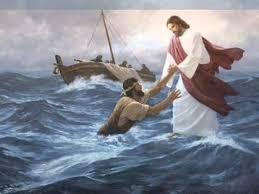
Today’s Gospel features one of the most iconic of all Christian scenes: Christ coming to the disciples upon the waves. Jesus walking on water has become almost a cultural cliché; it graces everything from ancient icons to dollar store postcards. In this passage, however, the disciples do not find our Lord walking upon the sea a comforting image: instead, they are terrified! In today’s Gospel, Peter and the other disciples are focused on keeping their boat ship shape so that they can continue netting enough fish to feed their families. Suddenly Peter sees the one true human walking on the waves and cries out, “Lord, if it is you, command me to come to you on the water!” Why would Peter say such a thing? Is he trying to test Jesus’s reality? Is he begging to share the novel experience of stepping across the sea? And what happens? Jesus tells Peter to join him in commanding the waves! While having dominion over water is impressive, this is something like a gateway miracle. What would it be like to have dominion not just only over something as basic as an unruly sea, but over something really uncontrollable—like your anger? It’s impressive to have dominion over leprosy, but what would it be like to have dominion over greed and covetousness? What would happen if we, like Peter, were boldly to request such astonishing powers? Just the same thing: Jesus would command us to come to Him. When we ask for Jesus’s help, he actually gives us the grace to overcome, not just petty things like winds and seas, but these utterly overpowering forces as well. There are times when we may experience this grace. We might be overwhelmed by compassion for another, forgiveness of our enemies or extravagant generosity… but then we get scared, we close off, we say, “I can’t just forgive that monster!” “I can’t just give away $10,000!” “I can’t walk on water!” And we begin to sink. But here is the secret: You can jump back into the boat, in the midst of your doubts, in the midst of your fears, you can stay in the water. There you can cry out with Peter, “Lord save me!” You can cry out to the one who is not only the perfect human, but God incarnate, “Lord make me an instrument of your peace! Lord Jesus Christ, Son of God have mercy on me!” And what will Jesus do? Reach out and grab your arm. He will hold you above the waves when you can’t walk upon them. Ask a former slave ship Captain like the Rev’d John Newton what it’s like to turn your back on your former life to become an anti-slavery crusader. He will be quick to tell you of the amazing grace with which Jesus imbues your life when you ask for it. But it takes faith to step out of the boat. It takes faith to be kind to those who are unkind to you. It takes faith to give away your money, your patience, your security. It takes faith to follow Jesus. As Bishop Robert Prevost in Peru, Pope Leo exemplified a deep spirit of accompaniment with those in need. When covid-19 hit Peru, oxygen shortages and economic collapse led to widespread deaths. He organised for oxygen supplies to be distributed. Despite the exhausting logistics of this operation, he persisted in working in solidarity with everyone involved. Sometime after the covid pandemic, during the floods in the region, he was present with those struggling as he stood knee-deep in flood waters, assisting in relief operations. Even at our most vulnerable moments, Jesus invites us to be courageous and audacious in trusting his steadfastness and his unfailing embrace of our frailties. Let us lean into the accompaniment of those who walk with us. Jesus looks steadfastly at us across the wind and water, and says, “Come”. And this is why, like the disciples in the boat, we must bow down and worship Jesus. We must allow him to have dominion over us, we must come before his altar, hear his word, receive his body and blood, and allow him to send us into the world to do his will.
- Yesterday
-
in my mind the best computer for me is my own brain
-
This is a nearly complete round-up of vocation milestones in the four US provinces of Dominican friars for 2026. Some of this information has been posted previously, but it makes more sense all in one place. Eastern Province:No word yet on incoming novices; 8 first vows; 3 solemn vows; the same 3 men were ordained deacons; 2 men were ordained priests. Central Province: 6 novices; 4 first vows; 5 solemn vows; the same 5 men will be ordained deacons, probably before the end of 2026; 2 men were ordained priests. Southern Province: 7 novices; 4 first vows; 1 priest. There are 81 friars in the Southern Province, of whom 20 are in initial formation, plus the 7 incoming novices. Their vocation milestones will increase for the next 5 or 6 years. Western Province: 9 novices; 4 first vows; 3 solemn vows; 4 men were ordained deacons; 5 men were ordained priests.
- Last week
-
-
Sounds like a contradiction in terms
-
L3.10 Je vous salut Marie, pleine de grace, le Seigneur est avec vous, vous etes benie entres toutes les femmes et Jesus, le fruit de vos entrailles est beni. Sainte Marie, Mere de Dieu, priez pour nous pecheurs, maintenant et a l'heure de notre mort. Amen
-
Windows I guess. It’s been a few years and I know some more shortcuts with windows, but I think I would adapt to Apple for most services. Back in the day, I used both and didn’t feel they were significantly different for most basic uses. Biggest issues rare the main software I would use and which systems it runs on.
-
L3.9 Je vous salut Marie, pleine de grace, le Seigneur est avec vous, vous etes benie entres toutes les femmes et Jesus, le fruit de vos entrailles est beni. Sainte Marie, Mere de Dieu, priez pour nous pecheurs, maintenant et a l'heure de notre mort. Amen
-
I am all for abortion being health care so long as it is made safe and causes no harm to both mother and unborn child.
-
fine sand
-
Which computer do you prefer? Windows or MacOS?
-
How many people are parents here?
CountrySteve937 replied to Anastasia13's topic in Catholic Debate Table
That's so funny 😂 -

2026 Entrances, Vows, and Ordinations
KaytePost replied to Luigi's topic in Catholic Vocation Station
Religious Sisters of Mercy Alma, clothed 3 novices and had 4 postulants enter within the past week, Check out each post on their insta page! https://www.instagram.com/almamercysisters/ - Earlier
-
All of the information below is taken from the web site of the American Cassinese congregation of Benedictine monks. I've grouped the announcements in chronological order within monasteries. ********************************************************************************************************************************** January 15, 2026~ Brother Thomas Lutz, O.S.B., Brother Atanasio Gacha, O.S.B., Brother Adam Stevens, O.S.B. and Brother Bruno Ramirez, O.S.B. were clothed in the monastic habit and received into the novitiate at Mary Help of Christians Abbey, Belmont, N.C. on January 14, 2026. ********************************************************************************************************************************** May 24, 2026 ~ Father Francisco Whittaker, O.S.B and Father José Rosa, O.S.B. were ordained to the priesthood and Brother Bosco Hough, O.S.B, Brother Finnbar McEvoy, O.S.B, and Brother Bede Maxson, O.S.B were ordained to the transitional diaconate on May 23, 2026 in St. Vincent Basilica in Latrobe, PA by the Most Rev. Edward Lohse, D.D., Bishop of Kalamazoo and a 1988 alumnus of St. Vincent Archabbey Seminary. 11 Jul 2026 - Brothers Lazarus (Emmanuel) Cacio, O.S.B. and Brother Wolfgang (Michael) Imboroni, O.S.B. were clothed in the monastic habit and received into the novitiate at St. Vincent Archabbey, Latrobe, PA on July 10, 2026. 11 Jul 2026 - Father Gabriel St. Hilaire, O.S.B., Brother Christian Riley, O.S.B., Brother Casimir Stynchula, O.S.B. and Br. James Manzer, O.S.B. made their simple (first) profession of monastic vows at St. Vincent Archabbey, Latrobe, PA during First Vespers for the Feast of St. Benedict on July 10, 2026. 11 Jul 2026 - Brother Aidan Sheridan, O.S.B. made his solemn (final) profession of monastic vows on the Feast of St. Benedict, July 11, 2026 at St. Vincent Archabbey, Latrobe, PA. ********************************************************************************************************************************* February 11, 2026 ~ Brother Denys (Robert) Janiga, O.S.B. made his solemn (final) profession of monastic vows at St. John’s Abbey, Collegeville, MN on February 10, 2026, the Feast of St. Scholastica. May 25, 2026 ~ Brother Felix Martin Mencias Babian, O.S.B., a monk of St. John’s Abbey in Collegeville, MN who is studying theology in Rome, was ordained to the transitional diaconate on May 23, 2026 in the Primatial Abbey Church of Sant’Anselmo on the Aventine hill of Rome by His Eminence Claudio Cardinal Gugernotti, Prefect of the Dicastery for Oriental Churches. 12 Jul 2026 - On the Feast of St. Benedict, July 11, 2026, Brother Jhonatan Olivan Romero, O.S.B. made his simple (first) profession of monastic vows, and Brother Hang Geum Augustine Oh, O,S.B. made his solemn (final) profession of monastic vows at St. John’s Abbey Church, Collegeville, MN. ********************************************************************************************************************************* 13 Jul 2026 - On Sunday evening, July 12, 2026 during Evening Prayer Fernando Limbo, José Muñoz and Bryan Scotton were received as postulants at St. Mary’s Abbey, Morristown, N.J. ********************************************************************************************************************************* 13 Jul 2026 - Father Bruno Mello, O.S.B. was ordained to the priesthood by the Most Rev. Gregory J. Studerus, D.D., on the Feast of St. Benedict, July 11, 2026 in St. Mary’s Church, Newark Abbey, N.J. NB: The two St. Mary's abbeys in New Jersey used to be one abbey, in Newark. During the 1960s, a majority of the monks voted to move to Morristown, while a minority of the monks voted to stay in the heart of Newark. Thus, there are two abbeys of the same name, twenty miles apart.
-
fine arts
-
The fact that many scripture passages become very familiar may mean that, in time, we fail to notice just what the passages are and therefore fail to be moved by the message they are conveying. Like all the prophets, Isaiah often feels the need to warn us of the dangers that can lead us astray, but by the same token, he also sees beyond, to how God always wants the best for us and that the best is accessible. The people for whom Matthew’s gospel was written were expecting the end of time to happen soon—within their lifetime. Miracle stories were told in part as a manifestation of the fulfillment of such expectations. The telling of a miracle story is a way for believers to clarify and express their faith, not a way for them to convert outsiders. Each miracle portrays an act of God in Jesus to deliver humans from something posing a threat to authentic life— living as the person who God created them to be. In this, each miracle exposes a separation from God, from our truest selves, and the need for salvation of many kinds: from sickness, thirst, hunger, demonic possession, being without purpose, natural disasters, and of course from sin and death. Finally, each miracle tells us something about the life, death, and resurrection of Jesus and holds this up to us in a shining, concise narrative. The picture of God wanting to quench our thirst and satisfy our hunger is part of that unfolding narrative in the scriptures which sees the Kingdom of God in terms of a great banquet. It links us to the underlying message of this week’s gospel – the ‘Feeding of the Five Thousand’ – which, in turn, points us to that banquet which we have in the gift of the Eucharist. Jesus withdraws to a deserted place by himself, but the crowds follow him. Jesus has compassion for them and cures the sick among them. Here, he delivers a multitude of humanity from sickness and returns them to their authentic selves—healed and restored to community. This takes a long time. So long that the hour is late and the disciples want to send the crowd off. Jesus surprises them by saying, ‘There is no need for them to go: give them something to eat yourselves.’ Jesus does not say that he will give them something to eat but tells the disciples “you give them something to eat,” inviting the disciples into this miracle as well, knowing that God provides for human life. It does not matter that these people are poor, desperate, tired, and do not have much to offer in return. The disciples are tasked to give food to everyone, regardless of social status. It is not a transactional relationship. God asks nothing in return. The disciples are like little children who go into the kitchen, open the refrigerator and say, “There’s nothing to eat!” While there is not apparent abundance to the disciples, there is also not nothing. At this point, Jesus takes the five loaves and two fish and he focuses on God. He looks up to heaven, where the people of the time believed God dwelled; he blesses and breaks the loaves; and he gives them back to the disciples. (Sounds familiar, doesn’t it?) Then the disciples give the bread and fish to the crowds, where everyone eats their fill, with twelve baskets left over. Jesus calls the disciples—and entrusted them to work together to feed the crowd, and he calls upon us to do the same. We are invited into this miracle story. We are reminded yet again that God provides for human life, and we must respond. How many times have we been given blessed nourishment—salvation of some kind—and not passed it along to people who needed it? Jesus passes the bread on to the crowd, and then the miracle happens. In chapter eight of his letter to the Romans, he does indeed wrestle with the huge challenge of a disordered world, but has no problem in concluding that ultimately Christ will triumph over every problem that presents itself: “neither death nor life, nor angels or rulers, nor things present nor things to come, nor powers, nor height nor depth, nor anything else in all creation, will be able to separate us from the love of God in Christ Jesus our Lord.” Jesus is holding the loaves and fishes out to you. Someone is waiting for you to share the blessing, to be invited into the miracle. What will you do?

-
dark arts
-
I'm a little late with this one - the entrance happened on April 25th, the feast of St. Mark, in Clyde, MO, at the monastery of the Benedictine Sisters of Perpetual Adoration: "For more than 150 years, the Benedictine Sisters of Perpetual Adoration in Clyde, Missouri, have been woven into the heart of northwest Missouri – and that story continued April 25 when they welcomed a new postulant into the congregation. Vanda entered during a Day Hour prayer service on the Feast of St. Mark, taking a sacred and exciting step on her journey of faith. She will spend the next year to 18 months fully participating in communal life and prayer while developing her personal prayer life, taking classes about monastic life and working in the monastery. She is originally from Minnesota and is a graduate of the United States Military Academy at West Point. She joins fellow 1980 graduate Benedictine Sister Nancy Rose Gucwa, OSB." That last part intrigued me, so I clicked on the link (in the original story, Sister Nancy Rose Gucwa is hyperlinked), below. It has a couple of interesting stories - one about Sister Nancy Rose, the other about four chaplains who gave up their life jackets to sailors and went down with their ship during World War II (a story I've never heard before). Sister Nancy Rose also draws interesting parallels between military life and religious life. I thought the whole story was interesting and worth sharing. https://benedictinesisters.org/duty-to-god-and-country/
-
dark chocolate
-
2026 Entrances, Vows, and Ordinations
KaytePost replied to Luigi's topic in Catholic Vocation Station
Dominican Sisters of Mary, Mother of the Eucharist had 3 perpetual professions. "Congratulations to Sr. Fulton Marie, Sr. Joseph Lucia, and Sr. Catherine Paul on your perpetual profession! We are so grateful you're with us "for all your life!" https://www.facebook.com/share/p/1LDmWV7yhk/ -
This retreat is September 11-13 in St. Petersburg, FL. ################################################################## Catholic Diocese of Saint Petersburg Calling all single women ages 18-30! Are you seeking to grow deeper in prayer, discover your unique identity as a woman, and learn more about God’s plan for your life? You’re invited to the upcoming Fiat Ministries Discernment Retreat at Saint Leo Abbey! Led by Team Fiat, this retreat brings together young women and consecrated religious sisters from various communities for a weekend of prayer, fellowship, small group discussions and joyful witness. Come encounter Christ and spend time discerning where God may be calling you. Saint Leo Abbey | Saint Leo, FL Cost: $50 Open to single women ages 18-30 Register today by clicking here: https://fiatministries.org/retreat-petersburg/
-
How many people are parents here?
veritasluxmea replied to Anastasia13's topic in Catholic Debate Table
I'm a parent. Just one. I can't imagine being a grandparent, but watching my and my husband's parents become grandparents has been really special, it's like seeing them in a new way.