All Activity
- Last week
-
I use is pretty regularly! Gives me an outlet to share my thoughts on books and see what others think. StoryGraph is a competitor which some people prefer, if you want options, but Goodreads has more users.
-
Redwoods monastery is a small community - maybe 10 or 11 nuns - in northern California. They received a new novice in February, Sr. Angela Jonah. The link has pictures and several paragraphs by Sr. Angela. https://www.redwoodsabbey.org/news/welcome-sr-angela-jonah/
-
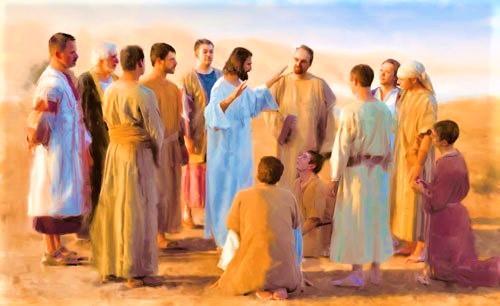
In the Gospel we are able to identify some key aspects of Christian discipleship. As Jesus travelled around Palestine, he was moved by the need for hope and healing among those who thronged to him, those Matthew calls, “harassed” and “helpless.” In Hebrew and Aramaic, the two languages familiar to Jesus, the word for compassion was found in the term for ‘womb.’ This means compassion for Jesus (and his Jewish contemporaries) was not felt in one’s head but in one’s heart. It is with this concern that he called his disciples and sent them out to proclaim that God’s reign was near, to heal, restore, cleanse, and liberate those to whom they were sent. He also reminded them that they would face and endure hatred, betrayal, opposition, and arrest, and yet endure all this with the help of God. What does this mission offered by Jesus mean for us today? To begin with, we are able to see that discipleship is a calling. Just as Jesus chose his twelve disciples in the gospel passage, Christ has called us and we follow him. It is only because God in Christ felt compassion according to the Gospels toward us that we have been called as the Church, the Greek word for Church – “ecclesia” – is composed of the words “ek,” meaning “out,” and “kaleo,” meaning “called.” We can say that discipleship is an outcome of God reaching out to make us his own. As disciples, we only respond to his calling and continue the work of Christ, always with his help. The words of Jesus to his first disciples, “Follow me,” continues to echo in and through the Church throughout history. However, the call to be a disciple is never about the disciples themselves. Christian discipleship is always about engaging with and living for others. The chosen disciples are sent out to proclaim the Good News of the kingdom and share God’s healing and liberation with others. This is why the Church, as the community of disciples, is also sent out into the world. A former Archbishop of Canterbury William Temple wisely noted, the Church always exists for its non-members. The Church, while it should certainly be a mutually comforting and loving fellowship of God’s children, cannot become self-centred or inward facing. The Church is a proclaiming community of disciples, in word and deed, to make a difference in the world. Discipleship and mission go hand in hand. Without mission, the Church loses its meaning and purpose of existence. Disciples go out to make more disciples – not for the sake of increasing numbers in the pews – but because God’s compassion moves within us. We may ask here: Is discipleship always a life of reaching out to others? Do we always have to keep proclaiming and sharing God’s gifts with others? Jesus gently reminds his disciples that they should also be willing to receive. They should be humble to receive help and support from others. Elsewhere, in Mark’s gospel, Jesus instructs his disciples to eat what is offered to them and stay where they are received. There is mutual care and compassion as disciples engage in mission. Connecting this with Christian discipleship, we may say that one cannot give without being open and humble to receive. When we engage with others in mission, Christ encourages us to receive as well. In other words, disciples are to be open to listening and learning from those to whom they are sent. Making disciples is not about patronizing. Rather, it is leading a life of humility, openness, receiving, and genuine dialogue. Finally, we can be proud of our calling as disciples, but we cannot forget that it is always a risk-taking business. Those who follow Jesus, because they strive for peace and justice, often find themselves in trouble with the powers of the world. Yet, we are never alone. The Holy Spirit, the Spirit of Christ, is with us and speaks through us. No matter who we may face or what our circumstances might be, we know that the Holy Spirit works through us. After all, it is God who has called and sent us in the first place. May we, as the Church whose head is Christ Jesus, continue to be mindful that we have been called as his disciples by the grace of God. May we remember that we are sent, filled with compassion, to “go out and make disciples,” boldly proclaiming the Good News of God’s kingdom in a broken world.
-
St. Gregory's Abbey in Shawnee, OK posted the following announcement on their Facebook page on 12 June. Highlights are mine: "Abbot Lawrence clothed Postulant Chien Ngo as a novice today, Friday, June 12, the Solemnity of the Sacred Heart. The clothing ceremony took place in the presence of the monastic community in the monastery Chapter Room. In keeping with ancient tradition, Abbot Lawrence conferred a new name as sign of the new way of life one assumes in the novitiate. Postulant Chien now is known as Brother Novice John Cassian. Born in Vietnam, Br. Nov. Cassian immigrated to the United States with his family when he was around ten years old. The family settled in the Dallas – Ft. Worth area, where he was living until beginning his time as a postulant at St. Gregorys. He holds a bachelors degree in Business Administration and for a time was a seminarian for the Diocese of Austin. The novitiate lasts one year. Novices experience an intense period of formation during the year, including courses on monastic spirituality, scripture, community history and personal development. They also engage in the daily liturgical prayer of the community, manual labor and other aspects of the fraternal life of the monastery. Br. Nov, Cassian joins Br. Nov. Sebastian and Br. Novice Isaac who are scheduled to complete their novitiate year at the beginning of September." This community had struggled with a lack of vocations and an aging group of monks. But then about fifteen years ago, they started getting a new monk just every now and then. Now, with the two novices about to profess first vows and the new novice, they have eight younger monks in a community of nineteen. So - praise God! - the community seems to be renewing itself.
-
I don't know how long ago she posted this blog, but here's Jen Fulwiler's take on the the event. https://www.facebook.com/reel/975534228658186
-
L2.6 Je vous salut Marie, pleine de grace, le Seigneur est avec vous, vous etes benie entre toutes les femmes et Jesus, le fruit de vos entrailles est beni. Sainte Marie, Mere de Dieu, priez pour nous pecheurs, maintenant et a l'heure de notre mort. Amen
-
Banned for feeding the system!
-
Most excellent! Let us know if there's anything we can do. Perhaps offer him a FREE subscription to Phatmass, where he can ask questions and get definitive answers from our excellent panel of experts!
-
supposedly he will start class in September and be Catholic at Easter.
-
-
Banned for taking 3 months to reply to the last ban.
-
- Earlier
-
Banned for thinking too little!
-
L2.5 Je vous salut Marie, pleine de grace, le Seigneur est avec vous, vous etes benie entres toutes les femmes et Jesus, le fruit de vos entrailles est beni. Sainte Marie, Mere de Dieu, priez pour nous pecheurs, maintenant et a l'heure de notre mort. Amen (pour les ames au purgatoire: y inclus Troy)
-
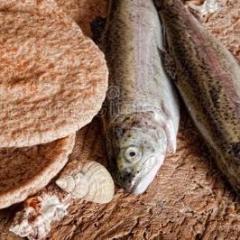
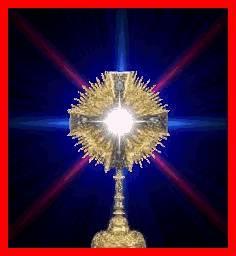
The Holy Eucharist is a meal. On one level, it’s a simple meal of bread and wine. But with prayers and the Holy Spirit, with faith, it is the Sacrament of the Body and Blood of Christ. It can take us back—back perhaps to our very first communion. It can bring back memories of other churches, other altars, other fellow-believers. But it is more than that. This is what makes a Catholic understanding of the Eucharist slightly different from some other perspectives. The Eucharist, this sacred meal of the Body and Blood of Christ by any name—is more than a memorial. The Eucharist takes us back, yes, in history and memory. But the Eucharist also grounds us in the present. And even more amazing, the Eucharist puts us in the future, where we eat and drink with the saints and martyrs, the angels and archangels, the fellow believers of all time and place. In the teaching on the Holy Eucharist, there’s a wonderful part that talks about the benefits of what we do, the benefits of Holy Communion, the Holy Eucharist, the Lord’s Supper. It says simply, “The benefits we receive are the forgiveness of our sins, the strengthening of our union with Christ and one another, and the foretaste of the heavenly banquet which is our nourishment in eternal life.” The “forgiveness of our sins” has to do with the past. I think it’s a complete misunderstanding to think that we have to be completely clean and sinless in order to receive Holy Communion. Pope Francis told us that “the Eucharist is not a prize for the perfect, but medicine and nourishment for the weak!” In saying this he is not suggesting we should go to the Eucharist without thoughtfulness, prayer and presence of mind; but he is also reminding us that all of us, without exception, come to the Eucharist as sinners in need of God’s healing grace and mercy. Pope Francis also provides guidelines for how the Eucharist should make a real difference in our lives and relationships with others. First, he says, we need to relate to people, sharing in their joys, hopes, sorrows and sufferings. Furthermore, this should enable us to reach out to the poor, sick and marginalised people, seeing in them the face of Christ. Second, experiencing God’s forgiveness in the Eucharist should enable us to see ourselves as “forgiven sinners” who are empowered to reach out in forgiveness to others. In this way the Eucharist enables us to overcome pride and division. When we partake of the Body and Blood of Christ, we are forgiven. We are forgiven again. Our sins are washed away at Baptism, but the ongoing accumulation of sin in our life meets its match in Holy Communion. Ignatius of Antioch called it the “medicine of immortality, and the antidote to prevent us from dying, … that we should live for ever in Jesus Christ.” Through the forgiveness of sins the Eucharist recalls the past and wipes the slate clean. The Eucharist is the ultimate palate cleanser. But the second benefit according to the Catechism sets us down squarely in the present. It has to do with strengthening our union with Christ and with one another. In a world that often suggests we live only for ourselves, that we protect at all costs what we think is ours; the unifying work of the Blessed Sacrament is counter-cultural. But it is live-giving. In Communion we are reminded that we need each other. The common cup and common bread underscore that we are not so different from one another, after all. Barriers of race and class and education, differences of national origin are all dissolved in the common chalice. Pope Francis adds Third, the Eucharist should enable us to become active disciples of Jesus Christ. While we Christians do not claim to be better than others, we nonetheless recognise our particular mission is to make Christ known and loved through a spirit of prayer, action and care for all our brothers and sisters, most especially those in need. In the words of Anglo-Catholic poet TS Eliot, Christ is “the still point of the turning world.” It is especially through our celebration of the Eucharist that our distracted, busy, turning worlds are stilled by the overpowering, silent mystery that camouflages the saving, liberating, loving presence of Christ in the broken bread and sweetened wine. For He is indeed truly present among us as the very life of the world. And so, grateful for the redemption of the past, thankful for the mystery of the moment, and glad for the hope that is ours, we celebrate this feast of bread and wine, of Body and of Blood.
-
That's what winning looks like! Cheers!!!
-
L2.4 Je vous salut Marie, pleine de grace, le Seigneur est avec vous, vous etes benie entres toutes les femmes et Jesus, le fruit de vos entrailles est beni. Sainte Marie, Mere de Dieu, priez pour nous pecheurs, maintenant et a l'heure de notre mort. Amen
-
I hope so! We are keeping boy/girl a surprise to everyone including ourselves. Just felt the kicking myself yesterday for the first time.
-
L2.3 Je vous salut Marie, pleine de grace, le Seigneur est avec vous, vous etes benie entres toutes les femmes et Jesus, le fruit de vos entrailles est beni. Sainte Marie, Mere de Dieu, priez pour vous pecheurs, maintenant et a l'heure de notre mort. Amen
-
Indeed - Pride is the first and worst of all deadly sins as no other sin can come about without first pride entering the heart.
-
-
“ pride is one of the seven deadly sins”
-
declining chair
-
Let us pray.
-