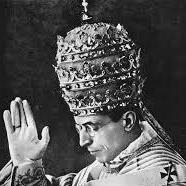
KnightofChrist Posted November 30, 2007 Posted November 30, 2007 [url="http://www.breitbart.com/article.php?id=D8T86D280&show_article=1"]Pope Criticizes Atheism in Encyclical[/url] [center][img]http://i36.photobucket.com/albums/e34/TheVoodookilla/pope_bring_it.jpg[/img][/center] VATICAN CITY (AP) - Pope Benedict XVI strongly criticized atheism in a major document released Friday, saying it had led to some of the "greatest forms of cruelty and violations of justice" ever known. In his second encyclical, Benedict also critically questioned modern Christianity, saying its focus on individual salvation had ignored Jesus' message that true Christian hope involves salvation for all. The document, titled "Saved by Hope," is a deeply theological exploration of Christian hope: that in the suffering and misery of daily life, Christianity provides the faithful with a "journey of hope" to the Kingdom of God. "We must do all we can to overcome suffering, but to banish it from the world is not in our power," Benedict wrote. "Only God is able to do this." An encyclical is the most important papal document, addressed to all members of the 1 billion-member Roman Catholic Church. In the 76-page document, Benedict elaborated on how the Christian understanding of hope had changed in the modern age, when man sought to relieve the suffering and injustice in the world. Benedict points to two historical upheavals: the French Revolution and the proletarian revolution instigated by Karl Marx. Benedict sharply criticizes Marx and the 19th and 20th century atheism spawned by his revolution, although he acknowledges that both were responding to the deep injustices of the time. "A world marked by so much injustice, innocent suffering and cynicism of power cannot be the work of a good God," he wrote. But he said the idea that mankind can do what God cannot by creating a new salvation on Earth was "both presumptuous and intrinsically false." "It is no accident that this idea has led to the greatest forms of cruelty and violations of justice," he wrote. "A world which has to create its own justice is a world without hope." He specifically cited Vladimir Lenin, the founder of the Soviet Union, and the "intermediate phase" of dictatorship that Marx saw as necessary in the revolution. "This 'intermediate phase' we know all too well, and we also know how it then developed, not ushering in a perfect world, but leaving behind a trail of appalling destruction," Benedict wrote. "The pope's concern is that you have secularizing forces that are trying to eliminate religion from public and private life," said Monsignor Robert Wister, professor of church history at Seton Hall University in the United States. "In most countries, political Marxism is dead (but) philosophical Marxism is very much alive and it fuels the secularizing philosophy often seen in Europe and North America," Wister said. At the same time, Benedict also looks critically at the way modern Christianity had responded to the times, saying such a "self-critique" was also necessary. "We must acknowledge that modern Christianity, faced with the successes of science in progressively structuring the world, has to a large extent restricted its attention to the individual and his salvation," he wrote. "In doing so, it has limited the horizon of its hope and has failed to recognize sufficiently the greatness of its task." The Christian concept of hope and salvation, he says, was not always so individual-centric. Quoting scripture and theologians, Benedict says salvation had in the earlier church been considered "communal"—illustrating his point by using the case of monks in the Middle Ages who cloistered themselves in prayer not just for their own salvation but for that of others. "How could the idea have developed that Jesus' message is narrowly individualistic and aimed only at each person singly? How did we arrive at this interpretation of the 'salvation of the soul' as a flight from responsibility for the whole, and how did we come to conceive the Christian project as a selfish search for salvation which rejects the idea of serving others?" he asked. While seeking to provide answers, he also says there are ways for the faithful to learn and practice true Christian hope: in prayer, in suffering, in taking action and in looking at the Last Judgment as a symbol of hope. Rev. Robert Gahl, professor of ethics at Rome's Santa Croce University, said the pope's message was "tremendously relevant" for today's materialistic societies "where people put hope in science and medical cures." "Saved by Hope," which Benedict largely penned this past summer while on vacation, follows his first encyclical, "God is Love," released last year. With these two encyclicals, which are the most authoritative documents a pope can issue, Benedict has explored two of the three Christian theological virtues: faith, hope and love. "We all ask ourselves if there will be a third encyclical on faith," said the Rev. Federico Lombardi, the Vatican spokesman. "It cannot be excluded, but it's not planned."
goldenchild17 Posted November 30, 2007 Posted November 30, 2007 [quote]In his second encyclical, Benedict also critically questioned modern Christianity, saying its focus on individual salvation had ignored Jesus' message that true Christian hope involves salvation for all.[/quote]
Thy Geekdom Come Posted November 30, 2007 Posted November 30, 2007 [quote name='goldenchild17' post='1427431' date='Nov 30 2007, 05:46 PM'] [/quote] What...do you disagree with the pope? Christian hope does include hope for all...if we don't hope for the salvation of all, we might as not hope for the salvation of ourselves. However, just because we hope for it doesn't make it the case. The pope didn't say that. In fact, he also made it quite clear in what I've read so far that there is a hell.
XIX Posted November 30, 2007 Posted November 30, 2007 The hope of salvation for all is not some quixotic hope that nobody will actually go to Hell. It means that there is no person for whom salvation is impossible. Christ died for everyone's sins, He didn't just limit himself to the people that He knew would be saved. Does anybody have that "Kiss My Pontifex Maximus" picture around anywhere?
goldenchild17 Posted November 30, 2007 Posted November 30, 2007 [quote name='Raphael' post='1427434' date='Nov 30 2007, 04:49 PM']What...do you disagree with the pope? Christian hope does include hope for all...if we don't hope for the salvation of all, we might as not hope for the salvation of ourselves. However, just because we hope for it doesn't make it the case. The pope didn't say that. In fact, he also made it quite clear in what I've read so far that there is a hell.[/quote] I hear what you're saying and I agree to a degree. Certainly one can hope for some sort of invincible ignorance I suppose, or hope that they will convert and be saved. But a realistic hope, from my understanding, doesn't include non-Catholics otherwise. The first thing that comes to mind when I read the article is a passage out of the syllabus of errors: 17. Good hope at least is to be entertained of the eternal salvation of all those who are not at all in the true Church of Christ.–Encyclical "Quanto Conficiamur Moerore," Aug. 10, 1863, etc. (CONDEMNED) I think there could be a degree of hope as the word is generally taken today. But a truly ordered hope is a hope for the salvation of those who are in the one true Church. I understand that there is a possibility that this can be interpreted to mean only Christians can be saved, so for that reason I stop short of calling this heresy. Personally, based on his history, I don't believe that's the case, but I admit with this particular statement it's possible to attain a degree of orthodoxy. But I do believe that it is certainly theologically erroneous to hold this position, and definitely creates a belief of hope, among the faithful, for the salvation of non-Catholics. This I think is a very dangerous thing to create for a shepherd of the faithful.
goldenchild17 Posted November 30, 2007 Posted November 30, 2007 [quote name='XIX' post='1427435' date='Nov 30 2007, 04:50 PM']The hope of salvation for all is not some quixotic hope that nobody will actually go to Hell. It means that there is no person for whom salvation is impossible. Christ died for everyone's sins, He didn't just limit himself to the people that He knew would be saved.[/quote] He certainly died for everybody. But that grace of His death only becomes efficacious in the elect, those who are faithful in the Catholic Church. Can everybody be saved? Yes, if they convert to Catholicism, or are somehow invincibly ignorant. Is there a degree of hope that everyone can convert and be saved, or be invincibly ignorant and be saved? Sure, but is salvation available to all, irregardless of creed if they do not convert? No.
KnightofChrist Posted November 30, 2007 Author Posted November 30, 2007 [quote name='goldenchild17' post='1427445' date='Nov 30 2007, 07:18 PM']I hear what you're saying and I agree to a degree. Certainly one can hope for some sort of invincible ignorance I suppose, or hope that they will convert and be saved. But a realistic hope, from my understanding, doesn't include non-Catholics otherwise. The first thing that comes to mind when I read the article is a passage out of the syllabus of errors: 17. Good hope at least is to be entertained of the eternal salvation of all those who are not at all in the true Church of Christ.–Encyclical "Quanto Conficiamur Moerore," Aug. 10, 1863, etc. (CONDEMNED) I think there could be a degree of hope as the word is generally taken today. But a truly ordered hope is a hope for the salvation of those who are in the one true Church. I understand that there is a possibility that this can be interpreted to mean only Christians can be saved, so for that reason I stop short of calling this heresy. Personally, based on his history, I don't believe that's the case, but I admit with this particular statement it's possible to attain a degree of orthodoxy. But I do believe that it is certainly theologically erroneous to hold this position, and definitely creates a belief of hope, among the faithful, for the salvation of non-Catholics. This I think is a very dangerous thing to create for a shepherd of the faithful.[/quote] Are we talking about the article or actual Encyclical?
Thy Geekdom Come Posted November 30, 2007 Posted November 30, 2007 [quote name='goldenchild17' post='1427445' date='Nov 30 2007, 06:18 PM']I hear what you're saying and I agree to a degree. Certainly one can hope for some sort of invincible ignorance I suppose, or hope that they will convert and be saved. But a realistic hope, from my understanding, doesn't include non-Catholics otherwise. The first thing that comes to mind when I read the article is a passage out of the syllabus of errors: 17. Good hope at least is to be entertained of the eternal salvation of all those who are not at all in the true Church of Christ.–Encyclical "Quanto Conficiamur Moerore," Aug. 10, 1863, etc. (CONDEMNED) I think there could be a degree of hope as the word is generally taken today. But a truly ordered hope is a hope for the salvation of those who are in the one true Church. I understand that there is a possibility that this can be interpreted to mean only Christians can be saved, so for that reason I stop short of calling this heresy. Personally, based on his history, I don't believe that's the case, but I admit with this particular statement it's possible to attain a degree of orthodoxy. But I do believe that it is certainly theologically erroneous to hold this position, and definitely creates a belief of hope, among the faithful, for the salvation of non-Catholics. This I think is a very dangerous thing to create for a shepherd of the faithful.[/quote] Notice that that quote from the Syllabus of Errors says "salvation of those who are not [b]at all[/b] in the true Church of Christ." The only way you could say that that means non-Cathoics Christians (as a rule) is if you reject Vatican II, in which case, under the definitions of those who reject Vatican II (a person rejecting an ecumenical council being non-Catholic), you would also stand condemned under your own accusation. But that's a different argument.
goldenchild17 Posted December 1, 2007 Posted December 1, 2007 (edited) KnightofChrist - I haven't finished the encyclical yet so I don't know. I was just commenting on the article you posted. If it's a fair representation of the encyclical then there's a problem. I understand that fair representation is probably unlikely from the Associated Press. But I worry that the encyclical is so poorly written that a major news source can misunderstand it so easily to where it creates so big of an error in Catholic thought. For the majority of Catholics (and I'm pretty sure I'm not exaggerating) that AP article is probably the extent of the information that they will get from the encyclical, most of them not going to the actual encyclical to read it for themselves. If this is the case, then not only is the Associated Press doing Catholic believers a great disservice, but the encyclical itself seems to be inadequate enough to where it creates this problem in the first place. Is it possible that the AP is purposely maligning the text for an agenda of their own? Possible, because everybody has an agenda of some kind, especially the media. But, to purposely take something that isn't in the text and present it is very dangerous policy for a news agency which can be taken to task for lying in their journalism and I'm not sure they would take that chance, knowing their readerbase and credibility given to them by the world. A much smaller publication? Sure, but not a world-wide source, I don't think. But I will finish the encyclical itself and see just what it actually says. Edited December 1, 2007 by goldenchild17
goldenchild17 Posted December 1, 2007 Posted December 1, 2007 [quote name='Raphael' post='1427484' date='Nov 30 2007, 05:54 PM']Notice that that quote from the Syllabus of Errors says "salvation of those who are not [b]at all[/b] in the true Church of Christ." The only way you could say that that means non-Cathoics Christians (as a rule) is if you reject Vatican II, in which case, under the definitions of those who reject Vatican II (a person rejecting an ecumenical council being non-Catholic), you would also stand condemned under your own accusation. But that's a different argument.[/quote] Yes that would be a different argument as I do reject Vatican II and especially the section which would allow for Protestants to be in some way "at all, a part" of the Catholic Church. For me, either your a part or your not. No, partly or mostly or anything of that nature. I would only stand condemned if I was not a part of the true Catholic Church, which I don't believe is the case. This also is another argument for another time. I would certainly argue that the syllabus holds the same meaning, but that is a different argument for another time.
Laudate_Dominum Posted December 1, 2007 Posted December 1, 2007 I tend to pay little attention to media blurbs, especially on doctrinal matters. Let's all read this puppy and discuss!! [url="http://www.vatican.va/holy_father/benedict_xvi/encyclicals/documents/hf_ben-xvi_enc_20071130_spe-salvi_en.html"]http://www.vatican.va/holy_father/benedict...e-salvi_en.html[/url]
XIX Posted December 3, 2007 Posted December 3, 2007 [quote name='goldenchild17' post='1427448' date='Nov 30 2007, 07:20 PM']He certainly died for everybody. But that grace of His death only becomes efficacious in the elect, those who are faithful in the Catholic Church. Can everybody be saved? Yes, if they convert to Catholicism, or are somehow invincibly ignorant. Is there a degree of hope that everyone can convert and be saved, or be invincibly ignorant and be saved? Sure, but is salvation available to all, irregardless of creed if they do not convert? No.[/quote] But that last question is a strawman with regards to this encyclical.
Aloysius Posted December 3, 2007 Posted December 3, 2007 In the context, the phrase is being debated here completely out of context. First off, it'd be better to be debating over a specific quote from the document rather than a media blurp, but secondly, the context of the media blurb indicates to me that the Holy Father made a distinction between individualist views of salvation and communal views of salvation; the point is that it is the entire community of the Church which gets saved, not a bunch of individuals who each individually get saved... it actually reinforces the EENS concept, and it has nothing at all to do with the debate about whether all might be saved or whether non-Catholics might be saved; it has everything to do with whether one is saved individually, or one is saved as part of a saved community (ie the Church) so goldenchild, this particular point you ought to side wholeheartedly with, though make it clear that this media blurb's wording is a ridiculous mischarecterization; I would like to see a good quote from the document relating to this; my suspicion is that the media blurb would be more in context if an insert was made into the quote: "In his second encyclical, Benedict also critically questioned modern Christianity, saying its focus on individual salvation had ignored Jesus' message that true Christian hope involves salvation for all [in the community of the Church]." while I am sure that you would disagree with Benedict's interpretation of EENS (as he sides with the post-conciliar emphases on possibilities for non-Christians), this particular point that he makes actually reinforces the dogma of EENS; let me paraphrase a quote of his from when he was Cardinal Ratzinger which shows the point he was trying to make: "We do not seek a Christ whom we have invented, for only in the real communion of the Catholic Church do we encounter the real Christ"... the dichotemy set up here is not Strict EENS vs. salvation possibilities outside but through the Church, the dichotemy is individual salvation vs. community salvation.
goldenchild17 Posted December 3, 2007 Posted December 3, 2007 [quote name='XIX' post='1428462' date='Dec 2 2007, 10:41 PM']But that last question is a strawman with regards to this encyclical.[/quote] maybe
Aloysius Posted December 3, 2007 Posted December 3, 2007 really, this is not at all the point being made. how is there a dichotemy between individual-based salvation and the theory of possible salvation outside of the Church?? actually, individual based salvation (which he is criticizing) would be more likely to propose the possibility of non-Catholics, even non-Christians, being saved. it'd be like saying "The pope criticized apples by saying that there are oranges"... it would be ridiculous; it makes more sense that he was distinguishing between individual salvation and communal salvation, hence it would be like "The pope criticized rotten apples by saying that there are good ripe apples to be had"
goldenchild17 Posted December 3, 2007 Posted December 3, 2007 possibly, I was just reading more from a perspective of knowing his (and his most recent predecessor's) history on that subject. This document doesn't refer to it explicitly, as you say, it's just how I was reading it which is why I said that. I read through the document and didn't really get the impression that there was a statement including salvation for all, as the news article insinuated. But I do still argue the point that if there had been something in the document, it would have been wrong. It doesn't bother me overly much that it's not in there though. Plenty of other documents of the recent popes have made the point.
Recommended Posts
Create an account or sign in to comment
You need to be a member in order to leave a comment
Create an account
Sign up for a new account in our community. It's easy!
Register a new accountSign in
Already have an account? Sign in here.
Sign In Now