Apotheoun Posted February 18, 2005 Posted February 18, 2005 [quote name='theculturewarrior' date='Feb 18 2005, 07:26 AM'] It's a tradition with a capital T? [/quote] Yes, it is. As St. John Damascene said, ". . . we prostrate ourselves toward the east. It is an unwritten tradition, deriving from the Apostles." [cf. Congregation for the Eastern Churches, [u]Instruction on Applying the Liturgical Prescriptions of the CCEO[/u], no. 107]
Cam42 Posted February 18, 2005 Author Posted February 18, 2005 Raphael, you are on the right track. And as far as the historical, Apotheoun is on the money. Look at the wording of General Instruction of the Roman Missal (GIRM)....It presumes that the priest is facing God with the people. In fact, the 1970 Missal instructs the priest to turn to the people at specific moments of the Mass, then to turn back to the altar. Look up the references in the Missal, No. 2. Further confirmation appears in the General Instruction on the Roman Missal, Nos. 122, 124, 146, 154, 157, 158, 165. [quote]....At the anamnesis or memorial, the priest, addressing God in the name of all the people, offers in thanksgiving the holy and living sacrifice: the Church's offering and the Victim whose death has reconciled us with God. The priest also prays that the body and blood of Christ may be a sacrifice acceptable to the Father, bringing salvation to all the world....(GIRM no.2)[/quote] [quote]The priest then goes to the chair. After the opening liturgical song, and with all standing, the priest and faithful make the sign of the cross. The priest says: In the name of the Father, and of the Son and of the Holy Spirit; the people answer: Amen. Then, [i]facing the people and extending his hands,[/i] the priest greets all present, using one of the formulas indicated. He or another minister may give the faithful a very brief introduction to the Mass of the day. (GIRM no.124)[/quote] [quote][i]The priest returns to the middle of the altar and, facing the people and first extending and then joining his hands,[/i] he invites the people to pray: Pray, brothers and sisters. The people stand and make their response: May the Lord accept this sacrifice. Then the priest, with his hands outstretched, says the prayer over the gifts. At the end the people make the acclamation, Amen.(GIRM no.146)[/quote] [quote]Then the priest, with his hands extended, says aloud: Lord Jesus Christ, you said. [i]After this prayer is concluded, extending and then joining his hands, he gives the greeting of peace while facing the people and says:[/i] The peace of the Lord be with you always. The people answer: And also with you. Then the priest may add: Let us offer one another a sign of peace. (GIRM no.154)[/quote] [quote][i]At the conclusion of the prayer, the priest genuflects, takes the Eucharistic bread, and, holding it slightly above the paten or above the chalice, while facing the people,[/i] says: This is the Lamb of God. With the people he adds, once only: Lord, I am not worthy. (GIRM no.157)[/quote] [quote][i]Next, facing the altar, the priest says inaudibly:[/i] May the body of Christ bring me to everlasting life, and reverently consumes the body of Christ. Then he takes the chalice, saying inaudibly: May the blood of Christ bring me to everlasting life, and reverently drinks the blood of Christ. (GIRM no.158)[/quote] [quote][i]Then, standing at the altar or at the chair, and facing the people, the priest says:[/i] Let us pray. There may be a brief period of silence, unless this has been already observed immediately after communion. With hands outstretched, he recites the Prayer after Communion, at the end of which the people make the acclamation Amen. (GIRM no.165)[/quote] I know the arguments against this line of reasoning, but facing the people is one direction and according to no. 158, facing the altar is another....but I think that the guidelines governing the Mass, of which nothing may be changed not even one word (according to Canon Law) apply. Anyhow, those are my thoughts......I know that many out there may think that this is rubrically rigid, but then again, it is the Mass. Thoughts? Cam42
Good Friday Posted February 18, 2005 Posted February 18, 2005 The practice of facing [i]versus populum[/i] is no doubt derived from a growing understanding of God present in the liturgical assembly and the fact that the priest is part of the liturgical assembly and not separate from it. However, the practice is an incorrect way of showing that. The practice turns the priest, rather than the action of the priest, into the object of attention -- when the priest faces [i]ad orientem[/i], he faces God in solidarity with the People of God and the object of attention is God, rather than the priest.
MichaelFilo Posted February 18, 2005 Posted February 18, 2005 Would it be wrong for a Western Rite priest to face the East nowadays? This seems like something that I will consider upon entering the priesthood. I have always faced the priest and seen the Host and Blood as the center of attention in the Eucharist-centered portion (or latter portion) of Mass. I don't imagine they'd be in my vision if the priest was turned around. This also led me to see the priest a the focal point, since he stands behind the Body and Blood. His actions and the Transformation are where my focus is at. I thought that is what the focus is supposed to be centered on. I don't think thats necessarily wrong.... hmm God bless, Mikey
Cam42 Posted February 18, 2005 Author Posted February 18, 2005 Mikey, [quote]Would it be wrong for a Western Rite priest to face the East nowadays?[/quote] Think about this...Everytime transubstantion takes place Christ returns. Insofar as this is the case, an argument can be proposed that the priest should be facing the taberncacle in order to be facing Christ as He returns. It isn't necessarily about a physical East, but rather a mystical East. [quote]I don't imagine they'd be in my vision if the priest was turned around.[/quote] When the priest elevates the host and the chalice, as the newly consecrated Body and Blood, it is placed directly in your line of sight. [quote]This also led me to see the priest a the focal point, since he stands behind the Body and Blood.[/quote] There is a theological prinicple that the priest should not be the focal point. The priest is merely the one who consecrates. He is the mediator in the Mass, insofar as he is acting in "Persona Christi." Remember the Mass is an offering to the Father through the son, with the Holy Spirit. This theological prinicple is askew when the priest doesn't face the same direction. The sense of being a mediator is lessened. [quote]His actions and the Transformation are where my focus is at.[/quote] Amen.
Good Friday Posted February 18, 2005 Posted February 18, 2005 [quote name='Cam42']Think about this...Everytime transubstantion takes place Christ returns. Insofar as this is the case, an argument can be proposed that the priest should be facing the taberncacle in order to be facing Christ as He returns. It isn't necessarily about a physical East, but rather a mystical East.[/quote] This would be further complicated by the fact that most tabernacles have been moved out of the sanctuary to a side altar or a separate chapel.
jezic Posted February 18, 2005 Posted February 18, 2005 (edited) [quote name='Apotheoun' date='Feb 18 2005, 08:36 AM'] You are absolutely correct. It is an ancient axiom that a man faces the one to whom he is offering prayer. Thus, when the priest faces the people, it symbolically sends the wrong message. Phenomenologically it appears as if the priest is praying to the people, and the people are praying to the priest. It is a complete and utter confusion of liturgical signs. God bless, Todd [/quote] missed the point. My own thoughts would be that the church should look to the example of our Lord. Jesus did both, at times he would face the crowds and pray but many times he would turn away or go off by himself. I don't think there can be "wrong" way to do it. Your prayer doesn't move the direction you are looking. Should it be important to you as a sign of devotion to face any direction, why would the church stop that? TO cam42 humans can't consecrate. God chooses to consecrate the offerings of ordained ministers. Edited February 18, 2005 by jezic
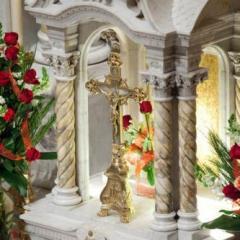
Apotheoun Posted February 18, 2005 Posted February 18, 2005 [quote name='Good Friday' date='Feb 18 2005, 03:26 PM'] [quote name='Cam42']Think about this...Everytime transubstantion takes place Christ returns. Insofar as this is the case, an argument can be proposed that the priest should be facing the taberncacle in order to be facing Christ as He returns. It isn't necessarily about a physical East, but rather a mystical East.[/quote] This would be further complicated by the fact that most tabernacles have been moved out of the sanctuary to a side altar or a separate chapel. [/quote] In Eastern Catholic Churches the altar is free standing, and the tabernacle, which is normally shaped to look like the Church building itself, is placed in the center of the altar. The priest is always facing the tabernacle, because during the readings he sits in the celebrants chair that is against the eastern wall behind the altar, and when he prays the prayers of the liturgy, he comes around to the western side of the altar and he turns and faces with the people toward the east. There are no side altars in Eastern Catholic Churches, nor is the tabernacle to be put off to the side or in a chapel. The tabernacle is always centrally located upon the Church's one altar of sacrifice within the sanctuary which is separated from the nave of the Church by the iconostasis.
Apotheoun Posted February 18, 2005 Posted February 18, 2005 [quote name='jezic' date='Feb 18 2005, 03:53 PM'] humans can't consecrate. God chooses to consecrate the offerings of ordained ministers. [/quote] Most certainly human beings do consecrate things to God. That is the whole point of the priesthood. God acts in, with, and through the priest, and so the priest must never be thought of as passive, because that is the Lutheran heresy. The priest acts in the person of Christ and consecrates the bread and wine into the body, blood, soul, and divinity of Christ.
Apotheoun Posted February 18, 2005 Posted February 18, 2005 [quote name='jezic' date='Feb 18 2005, 03:53 PM']missed the point. My own thoughts would be that the church should look to the example of our Lord. Jesus did both, at times he would face the crowds and pray but many times he would turn away or go off by himself. I don't think there can be "wrong" way to do it. Your prayer doesn't move the direction you are looking. Should it be important to you as a sign of devotion to face any direction, why would the church stop that?[/quote] For 2,000 years the Eastern Churches (and the Western Churches until 1970) have prayed facing east in expectation of the Lord's Parousia, and this orientation in prayer is not simply a human custom, rather, it is an Apostolic Tradition.
Cam42 Posted February 18, 2005 Author Posted February 18, 2005 [quote]humans can't consecrate. God chooses to consecrate the offerings of ordained ministers[/quote] Incorrect my friend. The priest most certainly consecrates bread and wine into the Body and Blood of Christ. By virtue of the indellible mark placed upon his soul....the priest can and does consecrate the Blessed Sacrament. There are only three requirements: 1. The matter is proper 2. The proper formula (words) are prayed over the matter 3. The intent of the priest is that of consecration. As to the rest of it, I have no problem with the altar being free standing. I think that some of the most beautiful churches in the world have free standing altars; St. Peter's, St. John Lateran, The National Shrine, The St. Paul Cathedral. Although traditional altars are fine as well. What I do not like is that there has been a mis representation of the posture of the priest as mediator. He is in "persona christi" and Christ is the mediator between humanity and the Father. When he is celebrating Mass facing the people, this is compromised. Cam42
Donna Posted February 19, 2005 Posted February 19, 2005 Mikey, as you walk through the last of your school years, I hope you can regularly attend a Latin Mass. Then you shall see what you see, over time, and continue to think, pray, discern.
StPiusVPrayForUs Posted February 19, 2005 Posted February 19, 2005 Please watch what you say I will not allow any sppx heresies on this website. Vianney
Guest JeffCR07 Posted February 19, 2005 Posted February 19, 2005 Todd, Cardinal Ratzinger has discussed at length the issue of eastward facing prayer in his book [u]Spirit of the Liturgy[/u]. In it, he notes the precedent and the need for proper orientation in prayer. However, acknowledging that it may not always be possible from a structural/functional point of view, he explains that the dilemma may very well be circumvented if the crucifix is moved to a central position. The crucifix acts as our spiritual East, and when looking upon it, we are made mindful of the promise of the Second Coming. Thus, Cardinal Ratzinger argues that the role of eastward orientation can be achieved by orienting prayer in such a way that it focuses on the crucifix. In this manner, even a Liturgy that is said [i]versus populum[/i] would retain the tradition of an eastward orientation, albeit in a slightly different manner. All that need be done, in his mind, is to place the crucifix in a central position so that when facing the priest, the congregation is oriented towards the crucifix and that when facing the people, the priest is also oriented in the same manner. - Your Brother In Christ, Jeff
Donna Posted February 19, 2005 Posted February 19, 2005 (edited) Then why not place the tabernacle between the people and priest? Oh, I get it, too clumsy/difficult. Do ppl realize how much more time we'd have on our hands, and what else we' might be discussing if a) the altars/alter rails, etc; had been retained or b) the little housewives would just give up that durn Old Mass! Edited February 19, 2005 by Donna
Apotheoun Posted February 19, 2005 Posted February 19, 2005 [quote name='JeffCR07' date='Feb 19 2005, 12:13 AM'] Todd, Cardinal Ratzinger has discussed at length the issue of eastward facing prayer in his book [u]Spirit of the Liturgy[/u]. In it, he notes the precedent and the need for proper orientation in prayer. However, acknowledging that it may not always be possible from a structural/functional point of view, he explains that the dilemma may very well be circumvented if the crucifix is moved to a central position. The crucifix acts as our spiritual East, and when looking upon it, we are made mindful of the promise of the Second Coming. Thus, Cardinal Ratzinger argues that the role of eastward orientation can be achieved by orienting prayer in such a way that it focuses on the crucifix. In this manner, even a Liturgy that is said [i]versus populum[/i] would retain the tradition of an eastward orientation, albeit in a slightly different manner. All that need be done, in his mind, is to place the crucifix in a central position so that when facing the priest, the congregation is oriented towards the crucifix and that when facing the people, the priest is also oriented in the same manner. - Your Brother In Christ, Jeff [/quote] Yes, I've read Ratzinger's book, and although he presents some interesting ideas about solving the present problems in the Roman Rite, I think that a better solution is for the West to simply return to its liturgical roots. In Western Churches there always used to be a large crucifix on the top of the rood beam (the beam that separated the sanctuary from the nave), and yet in spite of this, the priest always faced [i]ad orientem[/i], because the crucifix was not the focal point of the worshipping community, rather the eschatological east was, for Christ will return from the east, He will not return through the crucifix. So, the best solution to the present situation in the Roman Rite is not to have a small crucifix set on the altar between the priest and the people; but rather, it would be best to once again have the priest, in conformity with the inspired Tradition of the Apostles, turn east with the people during the Eucharistic sacrifice and thus offer the one all holy oblation of Christ to the transcendent Father. The modern Roman Rite sends mixed messages about the sacrifice of the Mass, because it presents a closed circle, where the priest and the people offer the prayers and sacrifice to each other. The answer to this problem of immanence is for the priest, as the head of the liturgical assembly, to turn and face east with the rest of the People of God, thus leading the entire assembly in prayer to the transcendent God, the source of all life and being. This re-orientation of the priest toward the eschatological east would signify the truth that he, as the icon of Christ the priest, is standing at the head of his people and is marching with them to the Parousia of the Lord That being said, the present situation in the Roman Rite is a novel practice (i.e., having the priest face the people during prayer) never before seen in the Church; and so, I pray that at some point in the future the Roman Rite will restore the Apostolic Tradition of the priest offering the Eucharistic sacrifice to the Father through the Son and in the power of the Holy Spirit, which is clearly signified by the priest celebrant's [i]ad orientem[/i] orientation in prayer. The irony in all of this is that the Vatican itself has forbidden the adoption of the [i]versus populum[/i] position in prayer (i.e., prayer facing the people) in the Eastern Catholic Churches, and has instructed the hierarchs of the east to suppress this novelty wherever it has arisen. God bless, Todd
MichaelFilo Posted February 19, 2005 Posted February 19, 2005 Apotheun, while I appreciate your speaking for the Eastern Churchs, some have changed with the 1970's changes. The Syriach Church is one... I am sure there maybe others to be found. God bless, Mikey
Apotheoun Posted February 19, 2005 Posted February 19, 2005 [quote name='MichaelFilo' date='Feb 19 2005, 08:09 AM'] Apotheun, while I appreciate your speaking for the Eastern Churchs, some have changed with the 1970's changes. The Syriach Church is one... I am sure there maybe others to be found. God bless, Mikey [/quote] Yes, I understand that some of the Eastern Churches have changed their practices, and that is precisely why the Vatican has ordered them to restore their former traditions. The Maronites have been heavily Latinized, and they will have a hard time in the future, because they, like all the Eastern Churches in communion with Rome, have been told that they are to de-latinize their liturgies and restore their ancient usages. The Ruthenian Church that I belong to was just ordered by the Metropolitan Archeparch to restore the practice of giving communion to babies. Sadly the Eastern Churches in communion with Rome have been affected by the Latin Rite's present crisis, but the Holy Father has ordered all the Eastern Churches to follow their own ancient traditions and expunge the various Latin influences within their liturgies. Now, as I said above, this means that the Maronites, and various other Eastern Churches, are going to have to educate their members on the true nature of the Eastern Christian Tradition. God Bless, Todd
Apotheoun Posted February 19, 2005 Posted February 19, 2005 The Maronite Church is a case in point. The Maronites are Eastern in name only, because they have adopted Latin vestments for their clergy, they use unleavened bread, which is contrary to the ancient practice of the Eastern Churches, and their Church buildings look no different than a Latin Rite parish, i.e., they don't normally have an iconostasis, and in addition their icons don't look Eastern, rather the images used in their Churches look no different than those used in Latin parishes. Moreover, the Maronites often have statues in their Churches, which is yet again a Western practice, etc., etc., etc. The Maronites are going to have a hard time doing what the Pope has [i]ordered[/i] them to do, i.e., become fully and completely Eastern in their liturgical life and in their spiritual and theological traditions. God bless, Todd
Recommended Posts